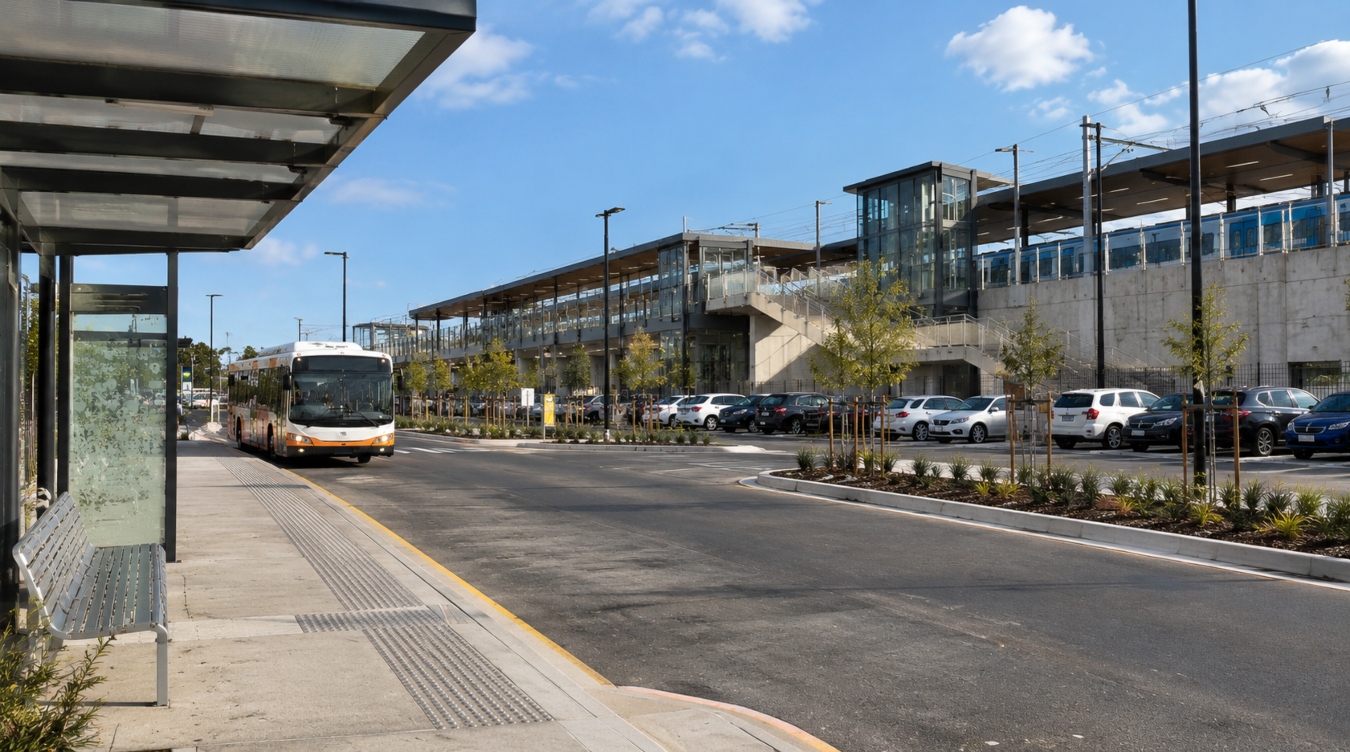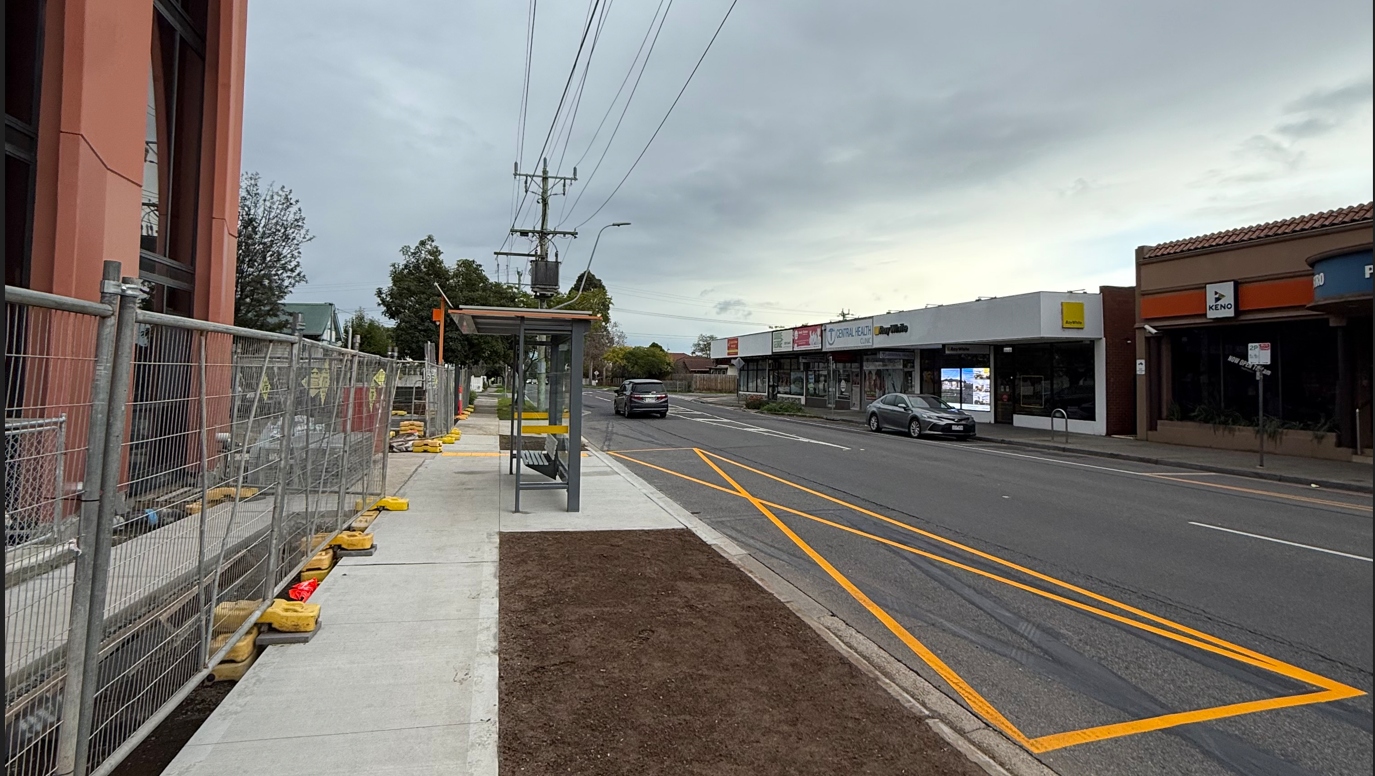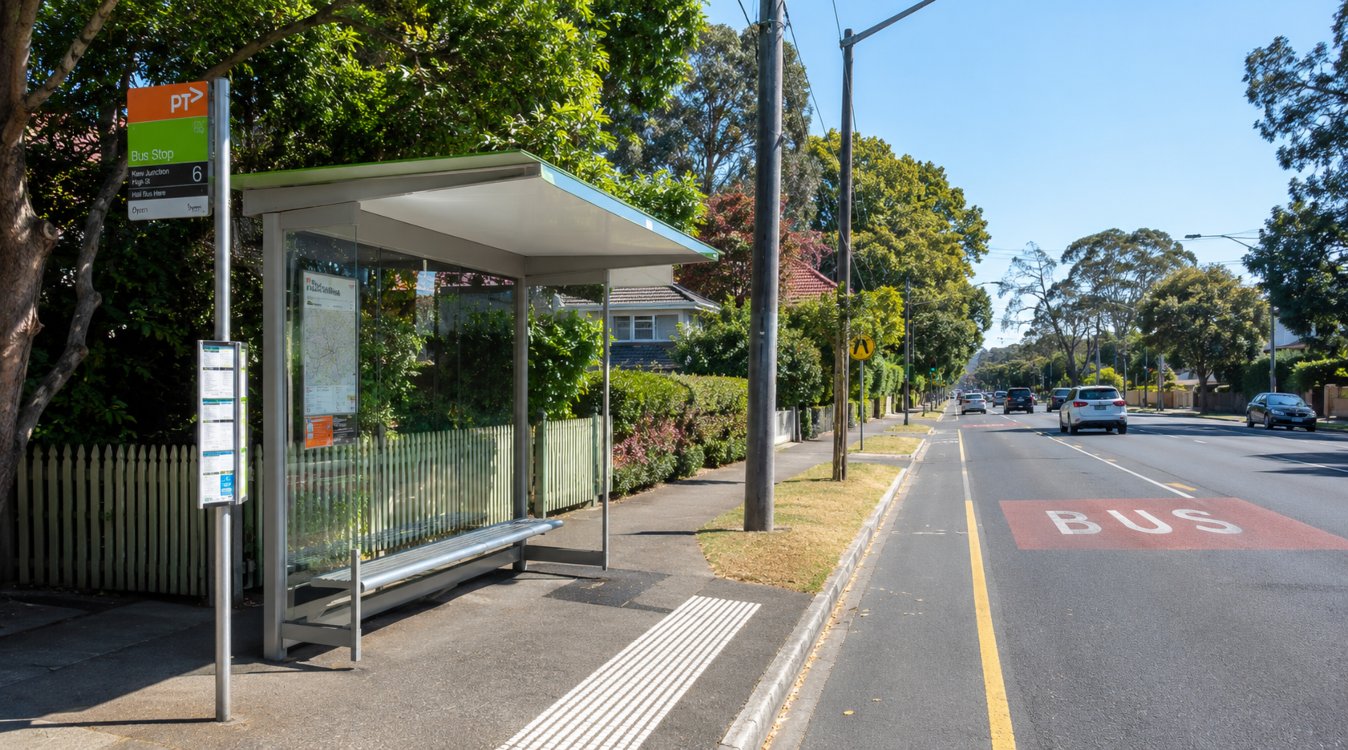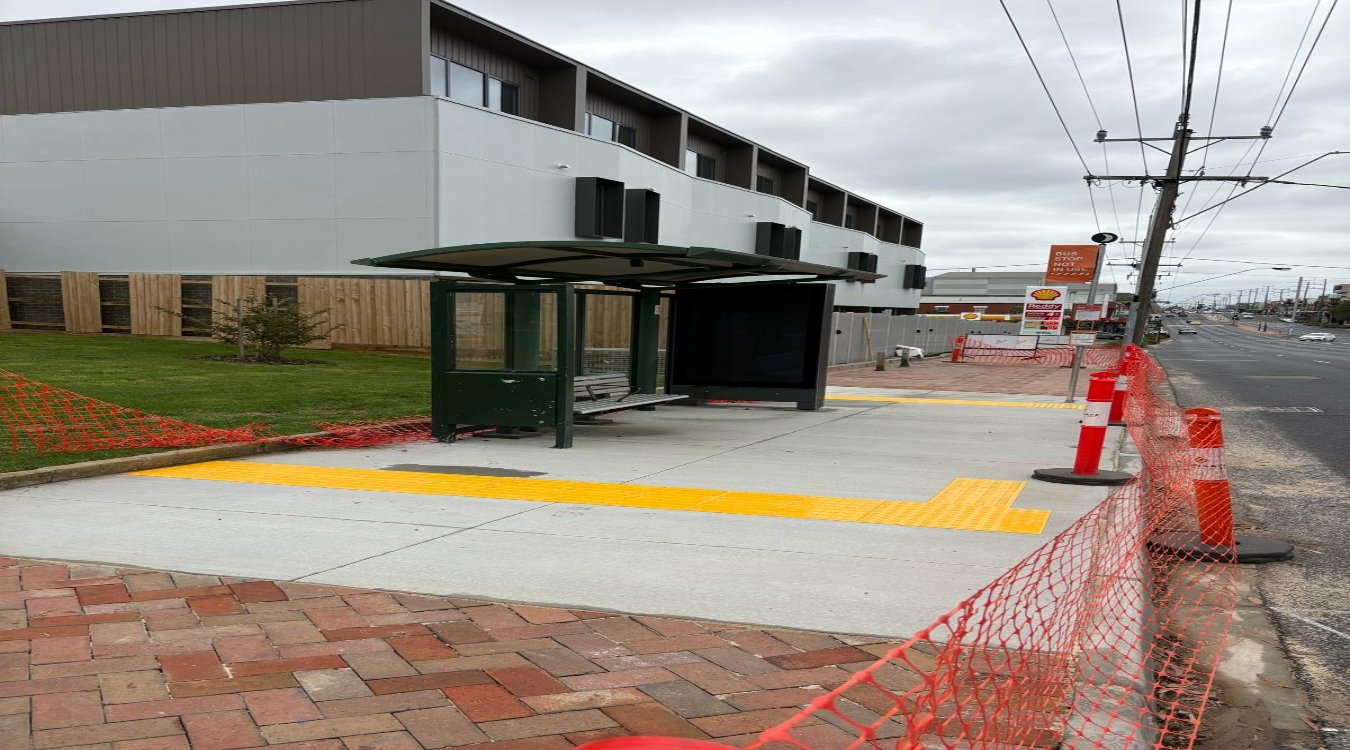
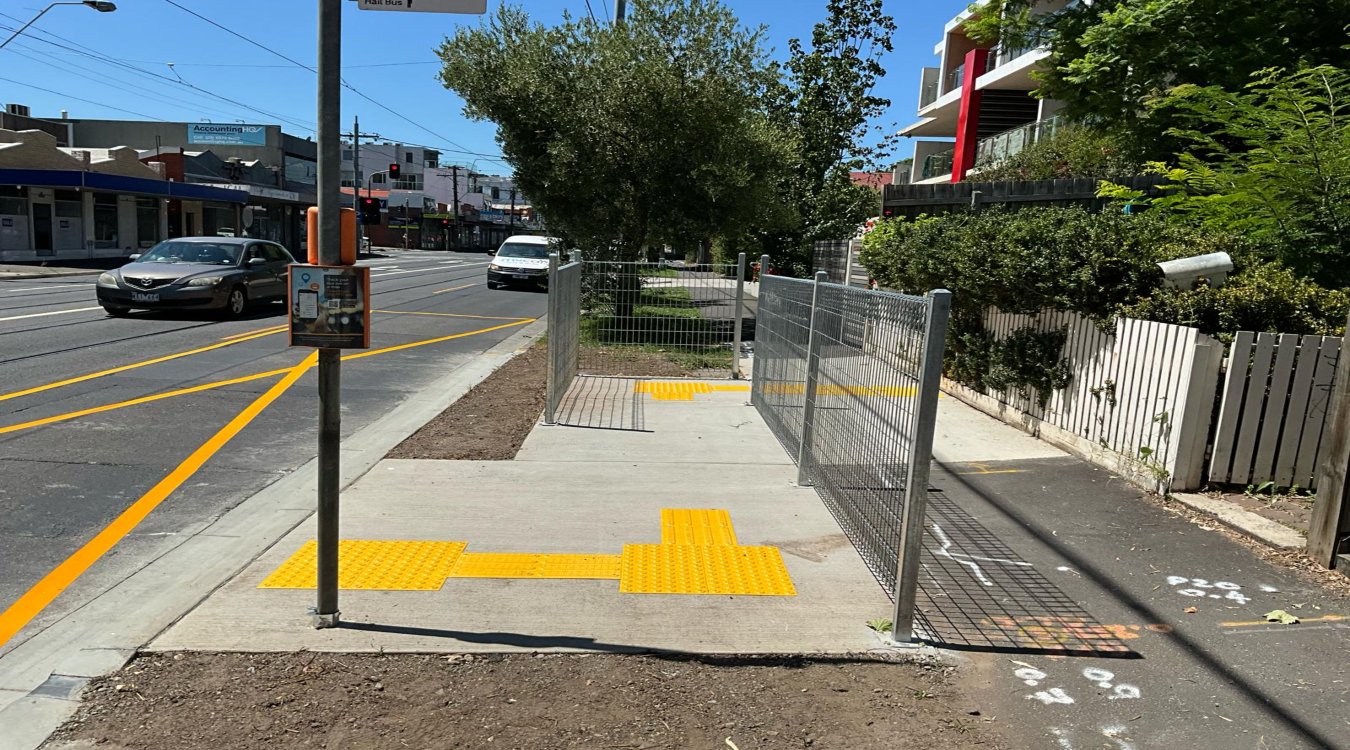
Public transport infrastructure must serve every member of the community, including people with mobility, vision, and accessibility needs. In Melbourne, bus stop construction is no longer just about pouring concrete and installing a sign. Councils now require strict adherence to accessibility legislation, engineering standards, and documented compliance before approving any new build or upgrade.
Under the Disability Discrimination Act 1992, public infrastructure must provide equitable access. For bus stops, this translates into clearly defined platform dimensions, compliant gradients, tactile ground surface indicators, accessible boarding points, and continuous paths of travel that connect safely to surrounding footpaths and crossings.
This guide outlines what councils require when assessing DDA-compliant bus stop designs, common compliance failures that can trigger rejection, and how early planning prevents costly rectification.
What “DDA-Compliant” Actually Means in Bus Stop Construction
Disability Discrimination Act (DDA) Overview
Federal Legislation Intent
The Disability Discrimination Act 1992 (DDA) is a Commonwealth law designed to eliminate discrimination against people with disability across key areas of public life, including access to premises, services, employment, education, and transport.
For infrastructure projects, the intent is clear: public spaces must be designed so people with mobility, sensory, and cognitive impairments can access and use them safely and independently.
Equal Access to Public Infrastructure
The DDA establishes the principle of equal access. In practical terms, this means public infrastructure must not create barriers that prevent individuals with disability from participating in everyday activities.
For bus stops, equal access includes:
- Safe and level boarding areas
- Wheelchair-accessible paths of travel
- Compliant kerb heights for low-floor buses
- Tactile ground surface indicators (TGSI) for vision-impaired users
- Slip-resistant surfaces and compliant gradients
Design must allow independent access — not assisted access.
Applicability to Transport Infrastructure
Public transport is specifically addressed under the DDA through transport accessibility requirements. Bus stops are a critical part of the transport chain and must meet accessibility standards, just as vehicles and stations do.
If a bus stop design fails to provide compliant boarding alignment, circulation space, or tactile guidance, it may be considered discriminatory under federal law. This places responsibility not only on transport authorities but also on councils, developers, and civil contractors delivering the works.
In Melbourne, DDA compliance is typically demonstrated by aligning with Australian Standards (e.g., AS 1428) and documenting this in engineering drawings submitted for council approval.
Transport Standards & Accessibility
Relationship Between DDA and Transport Infrastructure
The Disability Discrimination Act 1992 establishes the legal obligation for equal access, but it does not provide detailed construction dimensions or engineering tolerances. Those technical requirements are supported by applicable accessibility standards and transport-specific regulations.
For bus stop projects, compliance is typically demonstrated by aligning design and construction with:
- AS 1428 (Design for Access and Mobility)
- Disability Standards for Accessible Public Transport 2002
- State transport authority and local council engineering guidelines
In simple terms:
- The DDA sets the legal framework.
- Transport standards define the measurable technical requirements.
- Councils enforce compliance at the approval stage.
Bus stops are considered part of the “accessible path of travel” within the public transport network. If any element, boarding point, gradient, kerb alignment, or tactile placement fails to meet standards, the infrastructure may be deemed non-compliant.
How Compliance Is Measured in Real Projects
In practical terms, compliance is verified through:
1. Dimensional Checks
- Minimum platform width
- Clear circulation space
- Wheelchair turning areas
- Kerb height tolerances
2. Gradient Verification
- Maximum crossfall limits
- Maximum longitudinal gradient
- Drainage falls that do not exceed accessibility thresholds
3. Tactile Ground Surface Indicator (TGSI) Placement
- Correct offset from kerb
- Correct orientation
- Luminance contrast compliance
4. Continuous Accessible Path of Travel
- Unobstructed connection to existing footpaths
- No level changes beyond allowable thresholds
- Compliance with surface slip resistance requirements
5. Documentation & Engineering Drawings
- Spot levels and set-out dimensions
- Compliance notes referencing relevant standards
- Construction details showing slab depth, sub-base, and kerb integration
In Melbourne, bus stop designs lacking clear compliance documentation are often returned for revision before works begin. More critically, if construction proceeds without meeting standards, councils may require costly rectification.
Core Standards Melbourne Councils Reference
Disability Discrimination Act 1992
Legal Obligation
The Disability Discrimination Act 1992 (DDA) is binding Commonwealth legislation. It makes it unlawful to discriminate against a person on the basis of disability in areas including access to public premises, services, and transport infrastructure.
For bus stop construction in Melbourne, this creates a direct obligation on:
- Local councils
- Transport authorities
- Developers
- Civil contractors delivering the works
If a bus stop does not provide accessible boarding, compliant gradients, tactile guidance, and a continuous accessible path of travel, it may be considered discriminatory under federal law.
If a person with disability cannot safely and independently use the infrastructure, the obligation has not been met.
Consequences of Breach
Failure to comply with the DDA can result in serious legal and financial consequences.
- Formal Complaints: Individuals can lodge complaints with the Australian Human Rights Commission. These complaints may lead to conciliation processes or further legal action.
- Mandatory Rectification: Non-compliant infrastructure may require redesign and reconstruction. This often involves:
- Demolition and rebuilding of platforms
- Reinstallation of tactile indicators
- Regrading surfaces to meet allowable slopes
Rectification costs are typically far higher than designing correctly from the outset.
- Project Delays: Council approval can be withheld if documentation does not demonstrate compliance. This can delay construction programmes and affect funding timelines.
- Reputational Risk: Public infrastructure projects are highly visible. Accessibility failures can attract community scrutiny and media attention, particularly where vulnerable users are affected.
For bus stop projects in Melbourne, DDA compliance must be embedded into design, documentation, and construction methodology. Treating accessibility as a secondary consideration exposes councils and contractors to unnecessary legal and operational risk.
AS 1428
Access & Mobility Design Requirements
AS 1428 sets out the technical design requirements that ensure people with disability can access and use built environments safely and independently. For bus stop construction in Melbourne, this standard underpins the design of boarding areas, paths of travel, ramps, gradients, and tactile indicators.
In practical terms, AS 1428 governs:
- Continuous accessible paths of travel
- Wheelchair circulation and turning space
- Ramp gradients and landings
- Surface slip resistance
- Tactile ground surface indicator (TGSI) placement
- Kerb ramp interface with pedestrian routes
While the Disability Discrimination Act establishes the legal obligation, AS 1428 defines the measurable engineering criteria councils assess during approval and inspection.
Key Dimensional Controls
Compliance is determined by specific dimensions and tolerances. The most critical controls for bus stop design include:
- Minimum Clear Widths
- Accessible paths must maintain a minimum clear width free of obstructions.
- Boarding areas must allow sufficient space for wheelchair manoeuvring and passenger circulation.
- Wheelchair Turning Spaces
- Design must provide compliant turning circles at key locations such as boarding points and shelter areas.
- Street furniture must not intrude into required circulation zones.
- Ramp Gradients
- Maximum allowable ramp gradients are strictly defined.
- Landings must be provided at specified intervals depending on ramp length.
- Crossfall & Longitudinal Gradient
- Crossfall must remain within allowable limits to prevent instability for mobility device users.
- The longitudinal slope must not exceed the prescribed thresholds unless specific ramp treatments are applied.
- TGSI Placement
- Tactile indicators must be installed at precise offsets from kerbs and platform edges.
- Orientation and contrast must meet visibility and detection requirements.
- Surface Requirements
- Surfaces must be firm, stable, and slip-resistant.
- Abrupt level changes beyond allowable tolerances are not permitted.
Melbourne councils typically verify these controls through engineering drawings at the submission stage and through physical measurements during site inspections.
Public Transport & Road Authority Guidelines
DDA and AS 1428 establish the legal and technical accessibility framework, but bus stop projects in Melbourne must also align with the state transport authority’s and local council’s engineering requirements. These additional layers determine how a compliant design is implemented within live road networks.
Victorian Transport Authority Requirements
In Victoria, bus stop infrastructure must align with guidance issued by the Department of Transport and Planning (DTP).
Key expectations typically include:
- Standardised bus stop layouts and boarding point configurations
- Kerb alignment compatible with low-floor and accessible buses
- Clear zone requirements for passenger safety
- Setbacks from intersections and driveways
- Integration with road geometry and traffic flow
Transport authorities also assess whether the stop location allows safe bus docking without forcing buses to encroach into adjacent lanes or creating unsafe merging conditions.
In many cases, approval from the transport authority is required in addition to council engineering approval, particularly on arterial roads.
Council-Specific Engineering Standards
Each Melbourne council applies its own engineering design and construction standards, which may include:
- Minimum pavement thickness for bus stop pads
- Concrete strength requirements
- Sub-base preparation standards
- Drainage tie-in specifications
- Kerb and channel construction details
- TGSI material type and installation method
Councils will often require:
- Detailed set-out levels
- Spot heights demonstrating compliant gradients
- Construction cross-sections
- Material specifications referenced on drawings
Failure to document these clearly is one of the most common reasons bus stop designs are returned for revision.
Austroads Alignment Considerations
Road design and traffic safety elements are commonly assessed against Austroads guidance.
While Austroads is not legislation, its guides heavily influence how councils and road authorities evaluate:
- Bus stop positioning relative to intersections
- Sight distance requirements
- Lane width and shoulder design
- Traffic impact and safety considerations
- On-road vs indented bus bay configuration
Design must balance accessibility with traffic efficiency. For example:
- A fully accessible boarding point must not compromise sightlines.
- A compliant platform must not create hazardous vehicle pinch points.
- Drainage adjustments must not alter roadway performance.
Why Multi-Layer Compliance Matters
A bus stop can meet DDA and AS 1428 requirements but still fail approval if it does not satisfy:
- Transport authority operational standards
- Council engineering specifications
- Road safety design principles
Key Design Requirements Councils Assess
Boarding Point & Platform Dimensions
Boarding point design is one of the most heavily scrutinised elements in bus stop compliance. Councils assess platform geometry carefully because this is where accessibility either succeeds or fails.
A compliant boarding area must allow safe, independent access for wheelchair users, mobility aid users, parents with prams, and vision-impaired passengers, without obstructing pedestrian flow.
Minimum Width Requirements
The boarding platform must provide sufficient width to accommodate:
- Wheelchair manoeuvring
- Waiting passengers
- Circulation past the boarding area
In practise, councils expect:
- A clear, unobstructed accessible path of travel
- Additional width where shelters, poles, or furniture are installed
- Space that prevents wheelchair users from being forced into the traffic-side edges
Where bus stops are retrofitted onto narrow footpaths, insufficient width is one of the most common reasons designs are rejected.
If minimum widths cannot be achieved, full reconstruction or footpath widening may be required.
Clear Circulation Zones
Beyond raw width, the platform must maintain clear circulation space free from obstructions such as:
- Shelter posts
- Signage poles
- Seating
- Electrical pits or service covers
Key compliance principles include:
- The wheelchair turning space must not be compromised
- Street furniture must sit outside the required circulation envelopes
- No sudden level changes within the boarding zone
Councils assess not only dimension compliance but also functional usability. A technically wide platform that is cluttered with infrastructure may still fail inspection.
Alignment with Low-Floor Buses
Correct kerb and platform alignment ensures that:
- Bus doors align with the boarding pad
- Ramp deployment is safe and stable
- Vertical and horizontal gaps are minimised
Critical considerations include:
- Consistent kerb height along the boarding zone
- Straight docking alignment
- Adequate kerb length for articulated buses where required
Poor alignment can create excessive gaps between the bus and the platform, increasing risk for mobility-impaired users. Even small deviations in kerb profile or set-out levels can affect accessibility performance.
Kerb Height & Profile
Kerb height and profile are critical to achieving accessible boarding. Even if platform width and gradients comply, incorrect kerb detailing can prevent safe ramp deployment and create excessive vertical gaps between the bus floor and the boarding surface.
Melbourne councils assess kerb design carefully because it directly affects how low-floor buses dock and how passengers transfer from platform to vehicle.
Standard Kerb Heights for Accessible Boarding
For accessible bus stops, councils and transport authorities generally require kerb heights that align with low-floor bus specifications.
Typical requirements include:
- Raised kerb profiles designed specifically for bus docking
- Consistent height along the full boarding zone
- Straight alignment to prevent bus mis-docking
- Smooth interface between kerb and pavement surface
The kerb must support:
- Wheelchair ramp deployment
- Minimal vertical step between the bus and the platform
- Safe boarding for mobility-impaired passengers
In many cases, a standard road kerb profile is not sufficient. Bus stops often require a modified or “bus-friendly” kerb profile to improve alignment and reduce the horizontal gap.
Tolerance Limits
Compliance is not just about nominal height — it is about precision.
Councils typically check:
- Finished kerb height relative to design level
- Variation along the length of the boarding area
- Crossfall at the kerb line
- Settlement or edge deformation after construction
Even small deviations can result in:
- Ramp instability
- Increased gap between the bus and the platform
- Water ponding at the kerb edge
Tolerance failures often occur due to:
- Inaccurate set-out
- Sub-base settlement
- Poor compaction
- Improper tie-in with existing pavement
Practical Compliance Considerations
To avoid rejection or rectification:
- Survey levels must be verified before the concrete pour
- Sub-base preparation must support consistent kerb alignment
- Kerb transitions at each end of the stop must not introduce trip hazards
- Drainage must be designed without exceeding the allowable crossfall
Inaccessible docking conditions are among the most common issues identified during post-construction inspections.
Surface Gradients
Surface gradients are one of the most common reasons bus stop designs fail compliance checks. A platform may meet width and kerb requirements, but if slopes exceed allowable limits, the boarding area becomes unsafe for wheelchair users, mobility aids, and passengers with balance impairments.
Melbourne councils assess gradients carefully because they directly affect stability, drainage performance, and independent access.
Maximum Crossfall
Crossfall refers to the sideways slope across the platform surface.
If the crossfall is too steep:
- Wheelchairs can drift toward the road edge
- Mobility devices become unstable
- Ramp deployment may not sit flush
- Slip risk increases in wet conditions
To remain compliant:
- Crossfall must stay within prescribed accessibility limits
- Surface levels must be consistent across the boarding zone
- Drainage design must not compromise accessibility thresholds
One of the most common mistakes is increasing crossfall to improve drainage, only to exceed allowable accessibility limits.
Maximum Longitudinal Gradient
Longitudinal gradient refers to the slope along the direction of travel.
Excessive longitudinal slope can:
- Make wheelchair propulsion difficult
- Prevent safe stationary positioning while waiting
- Affect ramp stability during boarding
Councils typically require:
- Boarding areas that sit within allowable gradient ranges
- Transitional ramps where site constraints exceed limits
- Level landing zones at the primary boarding point
On sloped roads, achieving a compliant longitudinal gradient often requires partial reconstruction or a stepped platform design.
Slip Resistance Requirements
Gradient compliance alone is not sufficient. The surface finish must also meet slip-resistance standards.
Requirements generally include:
- Firm, stable, non-loose surfaces
- Textured finishes suitable for wet conditions
- Materials that maintain performance over time
Highly polished or worn concrete surfaces may fail inspection if they do not provide adequate slip resistance.
Slip resistance becomes especially critical at:
- TGSI interfaces
- Kerb edges
- Drainage collection points
Why Gradient Control Is Critical
Even minor deviations can trigger non-compliance.
The challenge in bus stop construction is balancing three competing factors:
- Accessibility limits
- Effective drainage
- Road geometry constraints
Proper design coordination among survey, drainage, and pavement teams is essential to ensure compliance and avoid costly rework.
Tactile Ground Surface Indicators (TGSI)
Tactile Ground Surface Indicators (TGSI) are mandatory at compliant bus stops. They provide detectable surface cues for people who are blind or vision-impaired, identifying boarding points, hazards, and safe waiting zones.
Incorrect TGSI installation is one of the most common compliance failures identified during council inspection.
Placement Requirements
TGSI must be installed:
- At the primary boarding point
- Along the kerb edge within the designated boarding zone
- In a continuous, straight alignment parallel to the kerb
The tactile layout must:
- Clearly indicate the edge of the boarding platform
- Avoid breaks or misalignment
- Sit fully within the accessible path of travel
Incorrect orientation (e.g., rotated tiles or inconsistent alignment) can render the tactile treatment non-compliant.
Offset from Kerb
TGSI cannot be placed directly against the kerb face. There is a prescribed setback distance that ensures:
- Safe cane detection before reaching the drop-off edge
- Consistent hazard warning positioning
- Adequate boarding circulation space
Common non-compliance issues include:
- TGSI is placed too close to the kerb
- Excessive setback reduces hazard detection effectiveness
- Inconsistent offset along the boarding length
Precise set-out during installation is critical. Even small positioning errors can require full removal and reinstallation.
Contrast Requirements
Tactile indicators must provide visual contrast against the surrounding pavement to assist passengers with low vision.
Councils assess:
- Luminance contrast between TGSI and the adjacent surface
- Uniformity of colour across installed tiles
- Long-term durability of colour finish
Using materials that fade quickly or fail to meet contrast thresholds can result in rejection.
Both tactile detection (via raised profile) and visual detectability must be satisfied simultaneously.
Why TGSI Accuracy Matters
TGSI installation is not a decorative element — it is a regulated safety feature. Placement, alignment, offset, and contrast must all comply with relevant accessibility standards.
Proper set-out, specification, and supervision during construction are essential to achieving first-time compliance.
Accessible Path of Travel
A compliant bus stop does not begin and end at the boarding pad. Councils assess whether passengers can travel safely and independently to and from the stop without encountering barriers. This is known as the Accessible Path of Travel (APT).
If the boarding platform is compliant but the connecting path is not, the bus stop may still fail accessibility requirements.
Continuous Path Connection
The accessible path must form an uninterrupted route from:
- Adjacent footpaths
- Nearby pedestrian crossings
- Parking areas (where applicable)
- Public spaces leading to the stop
The path must:
- Maintain compliant width
- Remain within allowable gradient limits
- Avoid abrupt level changes
- Provide firm, stable, slip-resistant surfaces
Obstruction-Free Clearance
Clear width must be maintained along the full accessible route.
Common obstructions that cause non-compliance include:
- Signage poles within circulation zonesx
- Electrical pits or covers protruding above the surface
- Tree roots causing surface deformation
- Street furniture encroaching into minimum width
- Overhanging elements reduce head clearance
Councils assess usable clearance, not just nominal design width. If a wheelchair cannot pass through the route without deviation, the route may be deemed non-compliant.
Linkage to Footpaths and Crossings
The bus stop must integrate properly with the surrounding pedestrian infrastructure.
Key considerations include:
- Seamless tie-in to existing footpaths
- Kerb ramps at intersections that meet gradient standards
- Alignment between the boarding pad and the crossing points
- Safe transition between road pavement and pedestrian surfaces
Where crossings exist near the stop, councils expect logical alignment that supports intuitive pedestrian flow. Misaligned ramps or poorly positioned stops can create unsafe crossing behaviour.
Why the Accessible Path Matters
Accessibility is assessed as a complete journey, not a single element. A technically compliant platform that connects to a non-compliant path still fails the broader accessibility objective.
Design coordination is essential to ensure:
- Platform levels match footpath levels
- Drainage adjustments do not create slope breaches
- Existing infrastructure does not create bottlenecks
For bus stop projects in Melbourne, the accessible path of travel is often where hidden compliance risks emerge, particularly in retrofit upgrades with space constraints.
Shelter & Street Furniture Placement
Shelters and street furniture must be positioned so they enhance passenger comfort without compromising accessibility. Councils assess not only whether a shelter is installed, but whether its placement interferes with circulation, boarding alignment, or required clearance zones.
Incorrect furniture positioning is one of the most common design-stage oversights in bus stop projects.
Clearance Zones
Shelters, seating, poles, bins, and signage must sit outside mandatory clearance areas.
Key principles include:
- Maintaining a clear, accessible path of travel through the platform
- Preserving the required boarding zone adjacent to the kerb
- Ensuring no structural posts intrude into circulation envelopes
Shelter frames often create hidden compliance risks if posts are placed within minimum width requirements. Even if the total platform width appears sufficient, intrusion into the clear zone can result in rejection.
Wheelchair Turning Space
Accessible design requires adequate turning space within or adjacent to the shelter area.
Councils typically assess:
- Whether a wheelchair can enter and exit the shelter
- Whether turning space is provided without blocking the accessible path
- Whether the seating layout allows mobility device positioning
If a shelter is installed without accounting for turning requirements, it may force wheelchair users into exposed areas or obstruct the main path of travel.
Avoiding Obstruction Within the Circulation Path
Street furniture must not:
- Reduce effective path width
- Create pinch points near boarding zones
- Interfere with tactile ground surface indicators
- Obstruct the door swing areas of the bus
Common errors include:
- Installing bins between the shelter and the kerb
- Placing signage poles within the boarding alignment zone
- Positioning seats that block the ramp deployment space
Practical Design Considerations
To achieve compliant placement:
- Map circulation zones before fixing shelter position
- Coordinate furniture layout with TGSI installation
- Maintain a clear separation between the waiting area and the boarding alignment
- Confirm final set-out dimensions before installation
Shelter and furniture placement should support, not compromise, accessible boarding. In constrained urban environments, careful layout planning often determines whether a project achieves first-time approval.
Drainage & Surface Integrity Requirements
Drainage performance is directly linked to compliance with accessibility requirements. A bus stop that accumulates water at the boarding point becomes unsafe for mobility-impaired users and often fails council inspections, even if all other dimensions comply.
In Melbourne projects, drainage design must balance accessibility gradient limits with effective stormwater management.
Preventing Water Ponding at Boarding Points
The boarding zone must remain free from standing water under normal rainfall conditions.
Ponding at the kerb edge can:
- Reduce slip resistance
- Interfere with ramp deployment
- Accelerate surface deterioration
- Create long-term settlement issues
Common causes of ponding include:
- Incorrect crossfall direction
- Inconsistent kerb height
- Poor tie-in to existing channel
- Sub-base settlement
Because the boarding point is typically flatter than the surrounding roadway (to meet accessibility limits), drainage design must be carefully detailed to avoid trapping water.
Minimum Falls Without Exceeding Gradient Limits
Drainage requires a surface fall, but accessibility limits the slope that can be introduced.
The challenge is achieving:
- Positive drainage flow
- Compliant crossfall limits
- Acceptable longitudinal gradient
- Smooth transitions to adjoining pavement
This is why survey coordination and detailed level planning are critical at the design stage.
Sub-Base Preparation
Surface performance depends on what sits below it.
Poor sub-base preparation can lead to:
- Differential settlement
- Kerb edge sinking
- Surface cracking
- Water infiltration and pumping
Best practise includes:
- Adequate excavation depth
- Proper compaction
- Suitable base material selection
- Stable transition to the surrounding pavement
Sub-base failure often presents months after completion, by which point accessibility gradients may no longer comply.
Concrete vs Asphalt Considerations
Both materials are used for bus stop pads, but each has implications for drainage and durability.
Concrete Pads
- Greater structural strength under bus loading
- More resistant to rutting
- Better long-term gradient retention
- Requires careful joint detailing
Asphalt Pads
- Faster installation
- Easier to integrate with the road pavement
- More susceptible to deformation under repeated braking loads
- Higher risk of rutting that affects drainage performance
Material selection must consider:
- Traffic volume
- Bus frequency
- Subgrade condition
- Long-term maintenance planning
Why Drainage Is a Compliance Risk
Poor drainage is one of the most common reasons bus stops fail council inspection.
Even when widths, kerbs, and tactile indicators meet standards, ponding water or surface settlement can result in rejection or costly rectification.
Effective bus stop design requires:
- Integrated drainage planning
- Accurate survey levels
- Controlled construction tolerances
- Material selection aligned with long-term performance
Common Compliance Failures Councils Flag
Even well-intentioned designs are often returned for revision because small technical oversights create measurable non-compliance. Melbourne councils assess bus stop projects against accessibility standards, engineering tolerances, and operational requirements — and they are precise.
Below are the most common issues identified during submission review and post-construction inspection.
Incorrect TGSI Placement
Tactile Ground Surface Indicators must meet strict requirements for positioning, alignment, and contrast.
Common failures include:
- Incorrect setback from the kerb
- Misalignment with the boarding zone
- Inconsistent installation across the platform length
- Insufficient luminance contrast
Because TGSI is a regulated safety feature, errors usually require full removal and reinstallation.
Excessive Crossfall
Crossfall is frequently adjusted to improve drainage, but exceeding allowable accessibility limits results in immediate non-compliance.
Typical problems:
- Slopes steeper than permitted thresholds
- Inconsistent levels across the boarding area
- Drainage falls compromise wheelchair stability
Gradient breaches are measurable on-site and difficult to dispute.
Insufficient Platform Width
Minimum clear widths must accommodate wheelchair manoeuvring and passenger circulation.
Failures often occur when:
- Shelters reduce usable width
- Existing narrow footpaths are not widened
- Obstructions are not factored into clearance calculations
Councils assess clear usable space, not nominal design width.
Obstructed Boarding Area
The boarding zone must remain free from physical obstructions.
Common issues include:
- Signage poles within the ramp deployment area
- Seating is placed inside the circulation envelope
- Bins or service pits positioned near the kerb line
Even minor obstructions can prevent safe wheelchair access.
Non-Compliant Kerb Alignment
Kerb height and alignment must allow proper bus docking.
Frequent failures:
- Inconsistent kerb height along the boarding length
- Excessive horizontal gap due to misalignment
- Settlement after construction affecting docking geometry
Kerb deviations directly affect ramp stability and gap tolerances.
Poor Tie-In with Existing Footpath
The accessible path must connect seamlessly to the surrounding infrastructure.
Problems arise when:
- New levels do not align with the existing footpath
- Level changes exceed allowable thresholds
- Surface transitions create trip hazards
- Drainage adjustments introduce gradient breaches
Retrofit projects are especially vulnerable to tie-in errors.
DOWNLOAD THE PRE-SUBMISSION AUDIT CHECKLIST, BEFORE LODGING DRAWINGS FOR COUNCIL APPROVALApproval Process: What Councils Expect Before Construction
Before construction begins, Melbourne councils require detailed documentation demonstrating that the proposed bus stop design complies with accessibility legislation, engineering standards, and road safety requirements. Approval is based on measurable technical evidence — not general intent.
Below are the core components councils typically assess during submission.
Engineering Drawings
Drawings must clearly illustrate the full scope of works, including:
- Plan view showing boarding zone, kerb alignment, and shelter location
- Cross-sections detailing pavement build-up
- Tie-in points to existing footpaths and road pavement
- Clear dimensioning of accessible path widths
Drawings should be scaled, coordinated, and consistent across all sheets. Missing dimensions or unclear layouts are common reasons for requests for further information (RFI).
Levels & Drainage Details
Councils expect detailed spot levels and surface grading information to confirm:
- Crossfall within allowable accessibility limits
- Longitudinal gradient compliance
- Positive drainage away from the boarding area
- Proper tie-in to kerb and channel
Submissions should include:
- Existing levels
- Proposed finished surface levels
- Drainage direction arrows
- Cross-sectional profiles
Failure to demonstrate how drainage is resolved without breaching gradient limits often results in rejection.
Compliance Annotations Referencing Standards
Design drawings should clearly reference relevant standards, including:
- Disability Discrimination Act 1992
- AS 1428
- Transport accessibility standards
- Applicable council engineering guidelines
Compliance notes should specify:
- TGSI installation requirements
- Kerb height tolerances
- Minimum path widths
- Gradient limits
This demonstrates that accessibility requirements were embedded into design, not treated as an afterthought.
Traffic Management Plan
If works occur within the road reserve, councils require a compliant traffic management plan outlining:
- Temporary pedestrian detours
- Vehicle traffic control arrangements
- Safe access during construction
- Protection of public transport operations
Plans must align with road authority requirements and ensure the safety of road users and pedestrians throughout the construction period.
Material Specifications
Material schedules should clearly state:
- Pavement type (concrete or asphalt)
- Concrete strength class
- Sub-base material and compaction requirements
- TGSI material and contrast specification
- Kerb type and profile
Councils assess whether materials selected will maintain compliance over time, particularly under repeated bus loading.
Why Pre-Approval Detail Matters
Incomplete or poorly coordinated submissions delay projects and increase costs. Councils expect documentation that proves:
- Accessibility compliance
- Structural integrity
- Drainage performance
- Road safety integration
Early coordination between design, survey, and construction teams significantly improves the likelihood of first-time approval.
Upgrade vs New Build: Compliance Differences
Bus stop projects in Melbourne generally fall into two categories: upgrading an existing stop or constructing a new compliant facility. While the accessibility standards remain the same, the path to compliance can differ significantly.
Understanding these differences early helps avoid redesign, scope creep, and cost escalation.
Retrofitting Constraints
Upgrading an existing bus stop often means working within fixed site limitations.
Common constraints include:
- Narrow existing footpaths
- Fixed road geometry
- Established kerb and channel profiles
- Mature street trees
- Adjacent property boundaries
In retrofit scenarios, achieving a compliant platform width and gradient may require widening works or partial road reconstruction. Simply resurfacing or replacing tactile indicators is rarely sufficient if the underlying geometry does not meet accessibility requirements.
Retrofitting also increases the likelihood of tie-in issues, where new compliant levels must integrate seamlessly with non-compliant surrounding infrastructure.
Existing Services Challenges
Underground services frequently complicate upgrade projects.
Typical conflicts include:
- Stormwater drains beneath the proposed boarding pads
- Electrical conduits serving street lighting
- Telecommunications pits within circulation zones
- Gas or water mains restricting excavation depth
Relocating services can:
- Extend approval timelines
- Increase construction complexity
- Trigger additional authority approvals
In some cases, service conflicts make it impractical to achieve compliant gradients or platform width without broader reconstruction.
When Full Reconstruction Is Required
A simple upgrade may not be sufficient if:
- Crossfall exceeds allowable accessibility limits
- The footpath width cannot accommodate compliant circulation
- Kerb alignment prevents proper bus docking
- Drainage cannot be resolved within gradient thresholds
- Sub-base failure has compromised structural integrity
When these conditions exist, councils may require full reconstruction of:
- The boarding platform
- Adjacent footpath sections
- Kerb and channel
- Road pavement interface
Although more disruptive initially, full reconstruction often delivers a longer-term compliant solution.
Budget Implications
Upgrades typically appear less expensive at first glance. However, hidden site constraints can significantly increase construction costs.
Budget differences often arise from:
- Service relocation
- Additional excavation and sub-base stabilisation
- Footpath widening
- Road pavement reconstruction
- Extended traffic management requirements
New builds, by contrast, allow design to be optimised from the outset. Clear geometry, coordinated drainage, and integrated compliance planning generally reduce the risk of rework.
Strategic Consideration
When evaluating upgrade versus new build, councils and project managers should assess:
- Whether existing geometry can realistically achieve compliance
- The likelihood of service conflicts
- Long-term durability under bus loading
- The cost of staged rectification versus full reconstruction
In many cases, investing in comprehensive reconstruction delivers better long-term compliance and durability, and reduces lifecycle costs, particularly in high-traffic bus corridors.
Cost Implications of DDA Compliance
Accessibility compliance is often viewed as an added expense during early project planning. In reality, the financial impact depends on when compliance is addressed, at the concept stage or after construction issues arise.
For bus stop projects in Melbourne, DDA compliance influences design scope, material selection, survey coordination, and construction precision. These factors can affect upfront cost, but they also reduce long-term risk.
Why Compliant Design May Increase Initial Cost
Designing to meet accessibility standards may increase initial project costs due to:
- Footpath widening to achieve a minimum platform width
- Reconstruction of the kerb and channel for proper bus docking
- Regrading surfaces to meet gradient limits
- Installation of compliant tactile ground surface indicators
- Detailed survey and engineering documentation
- Higher-strength pavement design to withstand bus loading
In retrofit projects, additional costs may arise from:
- Service relocation
- Sub-base stabilisation
- Drainage redesign
These are not “add-ons”; they are necessary to meet legislative and council requirements.
Long-Term Savings: Avoiding Rectification, Legal Risk & Rework
The real financial risk lies in non-compliance.
If a bus stop fails inspection or triggers accessibility complaints, costs can escalate due to:
- Demolition and reconstruction
- TGSI removal and reinstallation
- Regrading surfaces
- Traffic management for corrective works
- Project delays affecting funding cycles
There is also exposure to complaints under the Disability Discrimination Act 1992, which can result in reputational damage and mandatory rectification.
Designing correctly from the outset reduces:
- Variation claims
- Programme overruns
- Contractor-client disputes
- Long-term maintenance costs
Compliant geometry also improves durability, particularly when drainage and pavement strength are properly integrated.
Budget Planning Considerations
When budgeting for DDA-compliant bus stop construction, project teams should account for:
- Full platform reconstruction where necessary
- Survey and level verification
- Drainage integration within gradient limits
- Compliant kerb profiles
- Traffic management during construction
- Independent inspection and certification
Allocating adequate contingency for service conflicts and retrofit constraints is also critical.
Why Early Engineering Involvement Matters
Bus stop compliance is rarely achieved through isolated design decisions. Accessibility, drainage, kerb alignment, pavement strength, and tactile placement all interact. When these elements are addressed late in the process, redesign and cost escalation are almost inevitable.
Early engineering involvement ensures compliance is built into the project from day one, not corrected after submission.
Compliance Embedded at Design Stage
When engineering input begins at the concept stage:
- Platform geometry is planned around accessibility limits
- Drainage design respects allowable crossfall thresholds
- Kerb alignment supports correct bus docking
- TGSI layout integrates with circulation zones
This approach reduces the risk of submitting drawings that technically meet the intent but fail to meet measurable requirements.
Embedding compliance early also allows assessment of survey levels and road geometry before detailed design proceeds.
Avoiding Redesign Delays
One of the most common causes of approval delay is incomplete coordination between disciplines.
Late-stage changes often occur because:
- Drainage adjustments breach gradient limits
- Shelter placement reduces the required width
- Kerb heights do not align with bus specifications
- Footpath tie-ins introduce non-compliant slopes
Each redesign cycle impacts programme timelines, consultant fees, and construction scheduling.
Early engineering review reduces:
- Requests for further information (RFI)
- Drawing revisions
- Approval re-submissions
- On-site rectification
Coordinating Drainage, Kerbs, Pavement, and TGSI Together
Bus stop compliance is not a single checklist item. It is the result of coordinated engineering.
Effective integration requires:
- Survey validation of existing levels
- Precise kerb set-out for docking alignment
- Drainage design that works within accessibility gradients
- Pavement design capable of resisting bus braking loads
- TGSI placement that aligns with the boarding zone geometry
If these components are designed independently, conflicts emerge during construction.
Reasons to Hire Infra Projects for Bus Stop Design & Construction
- Compliance-Driven Contractor: Infra Projects approaches bus stop construction with compliance as a primary objective, not a finishing step. Accessibility, structural performance, and drainage integration are addressed as a unified system.
- Experienced with Council Approvals: Understanding council review processes, documentation expectations, and measurable inspection criteria reduces friction in approvals. Detailed drawings, level clarity, and standard references are prepared with assessment requirements in mind.
- Focused on First-Time Approval: The goal is straightforward: Design correctly. Document clearly. Construct precisely.
- Achieving first-time approval reduces delays, avoids rework, and protects project budgets, particularly in publicly funded infrastructure programmes.
Conclusion
Melbourne councils assess compliance based on documented standards, dimensional accuracy, and real-world usability. Width, gradients, kerb alignment, drainage, tactile placement, and path connectivity must all work together.
Proper coordination between survey, drainage, pavement design, and construction set-out ensures the boarding area performs as intended — under both accessibility and operational demands.
For councils, developers, and transport authorities, the objective is simple: infrastructure that achieves first-time approval and delivers safe, independent access for all users.
FAQs
1. What makes a bus stop DDA compliant in Melbourne?
A bus stop is considered DDA compliant when it provides an accessible boarding area, compliant gradients, correct tactile ground surface indicators (TGSI), appropriate kerb height for low-floor buses, and a continuous accessible path of travel — all aligned with the Disability Discrimination Act 1992 and AS 1428 requirements.
2. What is the minimum width required for a bus stop platform?
The platform must maintain sufficient clear width to allow wheelchair manoeuvring and safe passenger circulation. Councils assess usable, obstruction-free width — not just nominal design dimensions. Shelter posts, signage, and furniture must not reduce required clearance.
3. How high should a bus stop kerb be?
Kerb height must align with low-floor bus docking requirements to minimise vertical and horizontal gaps. The kerb profile must remain consistent along the boarding zone to support safe ramp deployment and independent access.
4. Do all bus stops require tactile ground surface indicators (TGSI)?
Yes. TGSI are mandatory at compliant bus stops to provide detectable cues for vision-impaired passengers. Placement, offset from kerb, orientation, and visual contrast must meet prescribed standards.
5. What is the maximum allowable slope at a bus stop boarding area?
Both crossfall (side slope) and longitudinal gradient (along the direction of travel) must remain within accessibility limits. Excessive slope is one of the most common reasons projects fail inspection.
6. How is drainage managed without breaching accessibility gradients?
Drainage must be achieved through careful level design and integration with kerb and channel, ensuring positive water flow without exceeding allowable crossfall limits. Survey accuracy is critical to achieving this balance.
7. Who approves bus stop construction in Victoria?
Approval is typically required from the relevant local council. Where works occur on arterial roads, additional approval may be required from the Department of Transport and Planning.
8. What documents are required before construction begins?
Councils generally require:
- Engineering drawings
- Spot levels and drainage details
- Compliance notes referencing standards
- Traffic management plan
- Material specifications
Incomplete documentation commonly delays approval.
9. Can an existing bus stop simply be resurfaced to meet compliance?
Not always. If the existing geometry does not meet gradient, width, or kerb alignment requirements, full or partial reconstruction may be required to achieve compliance.
10. What are the risks of non-compliance?
Risks include:
- Council rejection or delays
- Mandatory rectification works
- Increased project cost
- Potential complaints under federal accessibility legislation
- Reputational impact for project stakeholders