This technical blog documents how Infra Projects Group Pty Ltd delivered a full stormwater drainage capacity upgrade along Kingsway, Glen Waverley — one of Melbourne’s busiest eastern-suburbs commercial corridors — replacing aging 225mm-diameter pipelines with 300mm-diameter stormwater mains while managing live pedestrian traffic, a congested underground utility corridor, and a compressed construction programme that could not overrun by a single day.
If you are a council engineer, project manager, or infrastructure contractor looking for practical insights into delivering urban civil works under severe programme and stakeholder constraints, this case study is for you.
What Was the Kingsway Stormwater Pipeline Upgrade?
The Kingsway Underground Infrastructure Upgrade was an urban civil infrastructure project located in Glen Waverley, VIC 3150, within the City of Monash local government area. The project involved the excavation, removal, and replacement of existing stormwater drainage pipelines from 225mm to 300mm diameter, along with the construction of new stormwater drainage pits, service investigation and exposure works, concreting, and full surface reinstatement.
| Project Parameter | Detail |
| Location | Kingsway, Glen Waverley, VIC 3150 |
| Client / Authority | City of Monash |
| Contractor | Infra Projects Group Pty Ltd, Melbourne |
| Pipeline Upgrade | 225mm to 300mm diameter stormwater mains (33% capacity increase) |
| Key Constraint | Pre-Christmas approvals; pre-Chinese New Year completion |
| Site Environment | Live commercial precinct — active restaurants, retail, high pedestrian density |
Why Upgrade from 225mm to 300mm Diameter? The Engineering Rationale
Upgrading from 225mm to 300mm diameter delivers a 33% increase in internal cross-sectional area, which under the Manning equation for gravity-flow systems translates to a substantially greater volumetric flow rate at equivalent gradients. For a high-density commercial precinct like Kingsway — where undersized pipelines risk pit surcharging, surface ponding, and localised flooding during Melbourne’s high-intensity rainfall events — this capacity margin is essential.
Scope of Works
Infra Projects Group Pty Ltd was engaged as the principal civil infrastructure contractor, responsible for delivering end-to-end construction works required to support the underground pipeline capacity upgrade along the Kingsway pedestrian way. The scope encompassed five integrated work packages, each with distinct technical requirements and sequencing dependencies.
Site Survey and Service Investigation
- Detailed site inspection and ground assessment — A comprehensive topographic and geotechnical survey was conducted across the full pipeline alignment to establish existing surface levels, subsurface soil conditions, water table proximity, and excavation parameters. This data informed trench design, shoring requirements, and backfill specifications.
- Identification of underground services and utilities — Dial-Before-You-Dig (DBYD) records were obtained for all registered assets within the project corridor, cross-referenced against council asset registers and utility authority as-built drawings. Field verification was then performed to reconcile records against actual site conditions, as legacy infrastructure in established commercial precincts frequently deviates from recorded positions.
- Marking and tracing of existing pipelines and service lines — All identified services — water mains, gas lines, telecommunications conduits, and electrical cables — were physically marked at surface level using standard utility colour coding in accordance with AS 5488. Service depths and horizontal offsets were recorded at each crossing point to build a verified subsurface conflict map prior to any excavation activity.
Excavation and Underground Service Exposure
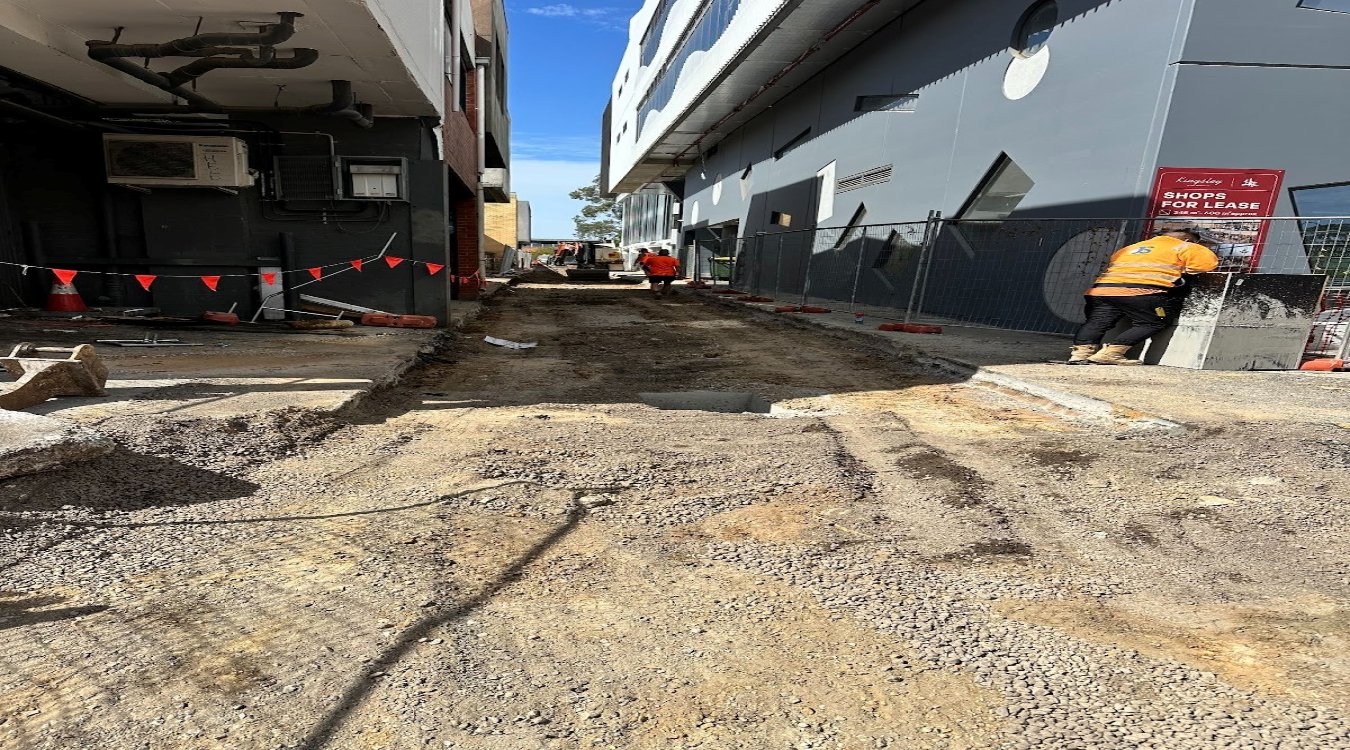
- Controlled excavation works in a congested commercial area — Open-trench excavation was performed along the pipeline alignment using a combination of mechanical excavators and hand tools. Trench dimensions were designed to comply with AS 4744 for steel support systems in trenching, with shoring installed at all excavation depths exceeding 1.5 metres. Spoil management and stockpile placement were planned to minimise footprint within the constrained pedestrian way corridor.
- Safe exposure of underground services using non-destructive digging (NDD) methods — Vacuum excavation was deployed at every identified service crossing and conflict zone prior to mechanical excavation. NDD potholing allowed millimetre-accurate verification of service positions, depths, and clearances, enabling our team to establish safe excavation envelopes around each live utility. This methodology eliminated the risk of accidental service strikes that would otherwise cause outages, safety hazards, and programme delays in the commercial precinct.
- Protection of existing infrastructure during excavation — Exposed services were physically supported using approved cradle and suspension systems to prevent displacement, loading, or vibration damage during adjacent trenching operations. Protection measures remained in place until backfill and compaction were completed to design levels around each service crossing.
Utility Upgrade Works
- Construction of underground service pits — New stormwater drainage pits were constructed to City of Monash specifications, including base slabs, pit walls, step irons, and grated covers. Each pit was positioned and levelled to achieve the design invert levels required for gravity-flow drainage across the upgraded network. Connections to incoming and outgoing pipelines were verified for grade, alignment, and hydraulic continuity.
- Removal and replacement of existing pipelines — The existing 225mm-diameter stormwater mains were removed in controlled sections, with each segment disconnected, extracted, and disposed of in accordance with council waste management requirements. New 300mm-diameter pipelines were installed on compliant bedding material, with haunching and backfill placed and compacted in accordance with AS/NZS 3725 to achieve the specified compaction density and structural support around the pipe zone.
- Upgrade of pipeline diameter from 225mm to 300mm to increase capacity — The 33% increase in internal cross-sectional area delivers a substantially greater volumetric flow rate under gravity-flow conditions, reducing the risk of pit surcharging and surface ponding during high-intensity rainfall events. All pipe joints were inspected for alignment and seal integrity prior to backfill, and the completed network was tested for grade compliance across the full alignment.
Concrete and Structural Works
- Concrete works required for structural support and pipeline protection — Concrete encasement was applied at identified conflict points where the new 300mm pipeline crossed or ran parallel to existing services at reduced clearances. Encasement provided both structural protection against third-party excavation risk and load distribution beneath trafficked surfaces. All concrete was placed, vibrated, and cured in accordance with AS 1379.
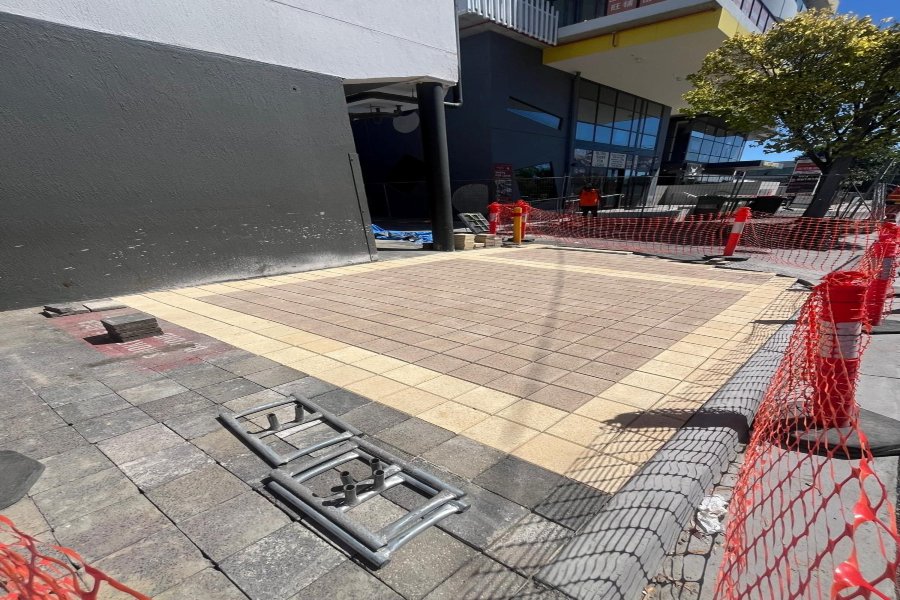
- Site finishing and stabilisation works — Full surface reinstatement was completed across all excavation zones, including concrete footpath slabs, pavement restoration, and finished surface levels matched to pre-construction profiles. Reinstatement quality was critical given the pedestrian way location — all surfaces were finished to achieve slip-resistance compliance and visual consistency with the surrounding commercial precinct.
Project Supervision and Execution
- Deployment of skilled manpower, equipment, and tools — A dedicated project team was mobilised comprising qualified civil tradespeople, plant operators (excavators, vacuum trucks, compaction equipment), and trade assistants. All personnel held current Construction Induction White Cards and were inducted to the site-specific safety management plan prior to commencing works.
- Continuous supervision to maintain quality and safety standards — A qualified project manager was present on-site full-time for the duration of works, responsible for daily programme monitoring, quality hold-point inspections, and real-time resolution of construction issues. Safety toolbox talks were conducted daily, and all works were executed under an approved Safe Work Method Statement (SWMS) for each activity.
- Coordination with authorities and other contractors involved in the project — The project management team maintained a continuous coordination interface with City of Monash inspectors, utility authority representatives, traffic management providers, and the state authority contractor scheduled for follow-on works. Interface meetings were held at key programme milestones to confirm handover readiness, site condition requirements, and demobilisation logistics.
Five Engineering Challenges That Defined This Project
Every urban stormwater upgrade involves trade-offs between programme speed, cost efficiency, safety risk, and stakeholder impact. The Kingsway project concentrated all of these pressures into a single compressed timeline. Here are the five challenges our engineering team had to solve concurrently.
1. Navigating a Congested Underground Utility Corridor
The Kingsway commercial strip sits above decades of accumulated buried infrastructure: water mains, gas lines, telecommunications conduits, and high-voltage electrical cables all sharing a crowded sub-surface corridor. Before any mechanical excavation could commence, we had to precisely locate every existing service to avoid accidental strikes that could cause service outages, safety hazards, and costly programme delays.
Our approach was to deploy non-destructive digging (NDD) using vacuum excavation at every service crossing and conflict zone. NDD potholing allowed our team to verify service positions, depths, and horizontal offsets with millimetre-level accuracy before any mechanical plant entered the trench. Every exposed service was then surveyed and recorded for as-built documentation, ensuring that the City of Monash’s asset register was updated with verified spatial data.
The result: zero service strikes across the entire project. Every existing utility — water, gas, telecommunications, and electrical — remained fully operational from first break of ground to final handover.
2. A Programme Bounded by Two Immovable Deadlines
The project calendar was bookended by two non-negotiable milestones. On the front end, all council permits and regulatory approvals had to be secured before government offices closed for the Christmas shutdown. On the back end, all physical works, surface reinstatement, and site demobilisation had to be completed before Chinese New Year celebrations — a major commercial and cultural event for the Glen Waverley precinct that attracts thousands of visitors and is critical to local business revenue.
There was no float in the programme. Any delay to approvals would push physical works past the festival deadline; any delay to physical works would impact both the celebrations and the state authority contractor queued for follow-on scope. Our project management team implemented daily progress monitoring against programme milestones, optimised resource sequencing to eliminate idle time, and deployed weekend and extended-shift operations where required to maintain compliance. The project was completed on programme with no overrun.
3. Critical-Path Dependencies with a State Authority Contractor
Adding to the time pressure, a state authority contractor was scheduled to commence their own surface and utility works on the same corridor immediately upon completion of our underground services. This created a hard interface dependency: any delay to the Infra Projects scope would cascade directly into the broader government delivery programme, affecting third-party mobilisation schedules and contractual commitments.
Our response was to plan the activity sequencing so that the underground works formed a reliable critical path with zero float consumption. Interface meetings were held with the state authority contractor throughout the project to confirm handover dates, site condition requirements, and demobilisation logistics. The handover was achieved on schedule with no disruption to the follow-on programme.
4. Parallel-Processing Council Approvals Before the Holiday Shutdown
Urban infrastructure projects in Victoria require multiple permits from local government and utility authorities: road opening permits, traffic management plans, environmental management plans, and service authority consents. In a normal programme, these are lodged sequentially, with each approval informing the next. That approach was not viable here, because government offices were closing for the Christmas break and sequential lodgement would not have achieved approval in time.
We prepared and lodged all approval applications in parallel across the City of Monash’s roads, drainage, traffic management, and environmental departments simultaneously. Our team proactively engaged with each department to resolve queries immediately, preventing any single approval stream from becoming a bottleneck. Every required permit was secured before the Christmas shutdown, allowing physical works to commence without administrative delay.
5. Coordinating Multiple Specialist Subcontractors During the Festive Season
The project required a coordinated team of specialist subcontractors: surveyors, NDD operators, pipe material suppliers, concreting crews, and qualified traffic controllers. All of these vendors were managing their own reduced availability and competing commitments during the festive period. Bringing every subcontractor into alignment on resourcing, sequencing, and site access required daily coordination from our project management team.
Vendor commitments were locked in well in advance of the holiday period. Daily coordination calls confirmed next-day resourcing, material deliveries, and site access arrangements. The result was zero supply chain disruptions: every subcontractor mobilisation occurred exactly as programmed.
How We Managed Pedestrian Safety Behind Live Restaurants
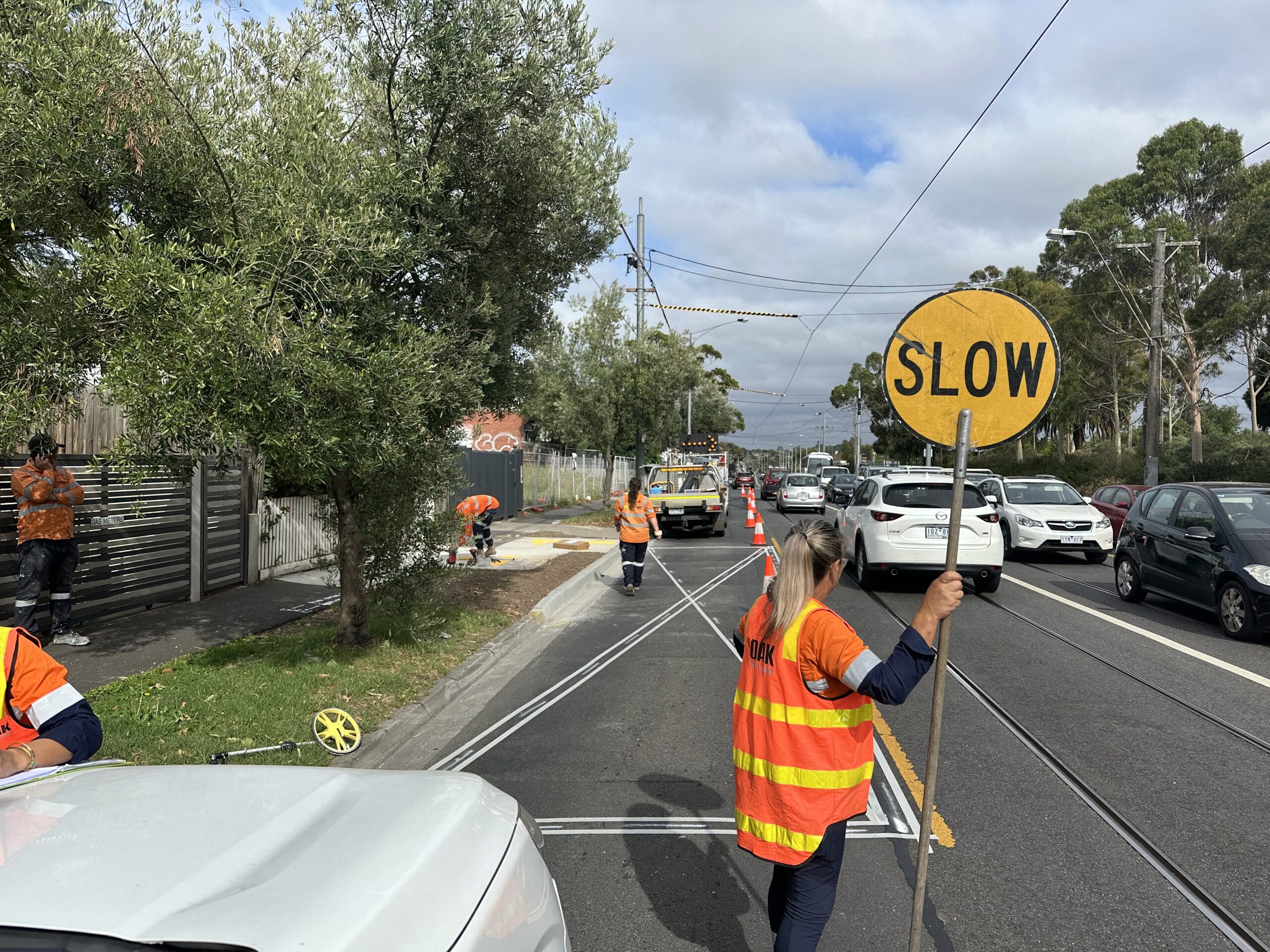
The single most critical risk on the Kingsway project was not engineering complexity or programme pressure — it was pedestrian safety. The pipeline alignment ran directly behind a row of active restaurants along Kingsway. These businesses depend on rear access for deliveries, waste collection, and customer foot traffic, which meant civil construction operations — including open trenches, heavy plant, and material stockpiles — were taking place within metres of the general public at all times.
Our structured pedestrian safety management plan was built on five control measures. First, we issued formal pre-commencement notifications to all adjacent shop owners and restaurant operators well before breaking ground, providing clear project timelines, daily contact details, and a dedicated escalation point. Second, our project manager maintained constant direct communication with every affected business throughout the project, addressing concerns in real time and adjusting work schedules to minimise disruption during peak trading hours. Third, temporary exclusion fencing was installed around the full perimeter of the active work zone, compliant with AS 1742.3, with warning signboards at all pedestrian approach points. Fourth, qualified traffic controllers and safety personnel were deployed on-site for the full duration of works, managing pedestrian movements and maintaining physical separation between the construction zone and public access routes. Fifth, clearly defined alternative pedestrian pathways were established with barriers and signage to ensure safe, continuous access to every business on the strip.
The outcome was zero safety incidents — no lost-time injuries, no near-misses involving pedestrians or the public, and no formal complaints from adjacent businesses. Every commercial operation maintained uninterrupted access throughout the full construction period.
Project Outcomes: What the Numbers Show
| Outcome Metric | Result |
| Safety Performance | Zero LTIs. Zero safety incidents. Zero pedestrian near-misses. |
| Underground Service Integrity | Zero service strikes. All water, gas, telecom, and electrical services fully operational throughout. |
| Programme Compliance | All works completed before Chinese New Year. State authority contractor handover achieved on schedule. |
| Stormwater Capacity Increase | 33% increase in pipeline cross-sectional area (225mm to 300mm diameter). |
| Regulatory Compliance | All permits secured pre-Christmas. Works executed per AS/NZS 3725, AS 4744, and AS 1742.3. |
| Stakeholder Impact | Zero formal complaints. Uninterrupted commercial access maintained. |
Key Lessons for Infrastructure Contractors and Council Engineers
This project reinforced several principles that apply broadly to urban stormwater and civil infrastructure delivery:
- Non-destructive digging is the baseline standard, not an optional extra, for any excavation in a congested urban utility corridor. The cost of NDD potholing is a fraction of the cost of a single service strike.
- Parallel processing of regulatory approvals can compress programme timelines dramatically when the alternative is sequential lodgement across multiple council departments and utility authorities. This requires proactive engagement and dedicated administrative resourcing.
- Pedestrian safety in live commercial precincts demands a dedicated project manager liaison who maintains constant, personal communication with every affected business. Signage and fencing are necessary but not sufficient — the human interface is what prevents complaints and builds social licence.
- Festive-season construction is achievable but only with early vendor commitment, daily coordination, and programme buffers that account for reduced subcontractor availability.
- Critical-path awareness must extend beyond your own scope. When a follow-on contractor depends on your completion date, interface meetings and formal handover protocols are essential to prevent cascading programme disruption.
Frequently Asked Questions
Q1. What is non-destructive digging (NDD) and why is it used in stormwater projects?
Answer – Non-destructive digging uses vacuum excavation to safely expose buried infrastructure without the risk of mechanical damage. In stormwater pipeline projects located within congested utility corridors, NDD allows engineers to verify the exact position, depth, and offset of every existing service before commencing mechanical excavation. This eliminates the risk of accidental service strikes and is considered the baseline standard for responsible civil construction in urban environments across Australia.
Q2. How much does upgrading from 225mm to 300mm diameter improve stormwater capacity?
Answer – A 300mm-diameter pipeline has approximately 33% more internal cross-sectional area than a 225mm pipeline. Under gravity-flow conditions governed by the Manning equation, this translates to a substantially higher volumetric flow rate at equivalent pipe gradients, significantly reducing the risk of pit surcharging and surface ponding during high-intensity rainfall events.
Q3. What Australian Standards apply to urban stormwater pipeline construction?
Answer – Key standards include AS/NZS 3725 for design and installation of buried flexible pipelines, AS 4744 for steel support systems in trenching, and AS 1742.3 for traffic control devices at work sites. Council-specific specifications and environmental management requirements also apply and vary by local government area.
Q4. Can stormwater infrastructure be upgraded in a live commercial precinct without disrupting businesses?
Answer – Yes, provided the project implements a structured pedestrian safety management plan that includes pre-commencement stakeholder notification, a dedicated project manager liaison for real-time communication with affected businesses, physical exclusion fencing and signage compliant with Australian Standards, qualified traffic controllers, and clearly defined alternative pedestrian access routes. The Kingsway project demonstrated that zero-disruption delivery is achievable even in a high-density restaurant and retail environment.
Q5. How long does a typical urban stormwater pipeline upgrade take?
Answer – Duration depends on pipeline length, depth, site access, utility congestion, and regulatory approval timelines. The Kingsway project was delivered within a compressed window between the Christmas government shutdown and Chinese New Year celebrations. Early parallel processing of council permits and daily programme monitoring were critical to achieving on-time completion.
About Infra Projects Group
Infra Projects Group Pty Ltd is a Melbourne-based civil infrastructure company with over a decade of experience delivering council-approved, DDA-compliant construction projects across Victoria. Our portfolio spans stormwater drainage upgrades, bus stop construction, car park delivery, footpath and driveway works, asphalt reinstatement, and coloured concrete installations. With more than 75 completed projects across the state, we bring project management discipline, technical expertise, and proactive stakeholder engagement to every civil infrastructure engagement.
Ready to discuss your next infrastructure project? Contact us at infra-projects.com.au | info@infra-projects.com.au | 0430 314 949