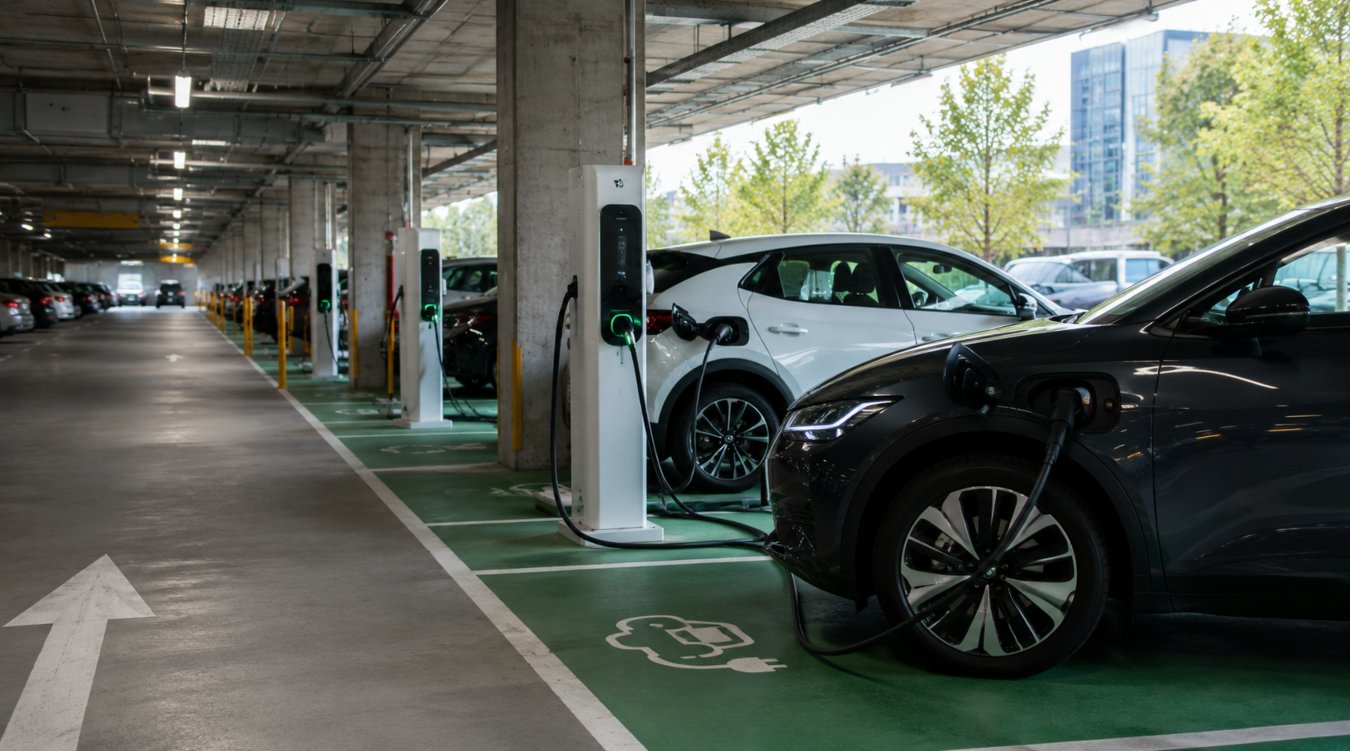
Electric vehicles are no longer a niche consideration for Australian businesses. In Victoria alone, the state government allocated an additional AUD $688,500 in grant funding on 28 April 2026 to expand the public EV fast-charging network across the state, adding 22 charging stations and 43 individual charge points across 13 Victorian locations (Source: Victorian Government — Destination Charging Across Victoria Program). In April 2026, the Victorian Government also released its EV Charging Regulatory Statement, setting out new steps to unlock the rollout of EV chargers across the state (Source: Victorian Government — EV Charging Regulatory Statement, April 2026).
For commercial property managers, retail centre operators, industrial facility managers, and developers, the message is unambiguous: EV charging in car parks is shifting rapidly from a competitive advantage to a regulatory obligation. And with the National Construction Code 2025 (NCC 2025) now mandating EV-readiness infrastructure for new commercial developments, the civil and line marking implications for car parks across Melbourne and Victoria are significant.
This guide is written for property and facilities professionals who need to understand exactly what EV charging bays require from a car park construction and line marking perspective — not just the electrical side, but the pavement works, bay geometry, DDA compliance, and signage obligations that sit squarely within the civil domain.
Quick Answer: What Do Victorian Businesses Need to Know About EV Charging Bays in Commercial Car Parks?
Commercial car parks in Victoria must now plan for EV charging infrastructure under NCC 2025. Adding EV bays involves more than installing chargers — it requires compliant bay geometry under AS/NZS 2890.1:2021, specialist line marking under AS 1742.11, DDA-accessible bay provision under AS/NZS 2890.6, and often pavement or civil works to accommodate the physical footprint of charging equipment. Getting the civil and line marking elements right is as important as the electrical installation.
Why Commercial Car Parks in Melbourne Can No Longer Ignore EV Infrastructure
Across Melbourne’s commercial and industrial zones, EV adoption is accelerating. The Australian Building Codes Board (ABCB) has confirmed that EV charging requirements under the National Construction Code have moved EV infrastructure from a voluntary consideration to a mandatory condition of development approval, with councils across Melbourne now routinely requiring detailed EV management plans as part of commercial development applications (Source: ABCB — Advisory Note: EV Charging). This reflects a fundamental shift in how Melbourne councils are approaching development applications: EV-readiness is no longer a suggested amenity — it is a condition of approval.
The trigger for this shift is regulatory. Since May 2024, all new apartment builds in Victoria have been required to be EV Ready under the National Construction Code 2022. NCC 2022 introduced these requirements — effective in Victoria from 1 May 2024 — and they remain in force under NCC 2025. Under clause J9D4 of the NCC, new commercial car parks in Class 5 and 6 buildings (offices and retail) must size EV distribution boards for a minimum of 10% of car park spaces, while Class 3, 7b, 8, and 9 buildings (hotels, warehouses, factories, public buildings) must size for 20% of spaces (Source: ABCB — J9D4 Facilities for Electric Vehicle Charging Equipment); also NCC 2022 Commercial Energy Efficiency Webinar). For businesses building or substantially upgrading commercial car parks in Melbourne and Victoria, this means EV infrastructure planning is no longer optional.
Beyond compliance, there is a practical competitive dimension. Retail centres, office buildings, and industrial facilities that offer EV charging attract and retain tenants and customers. Green building rating schemes — Green Star and NABERS — award additional credits for installed chargers, influencing asset valuations and investor appeal. The Australian Government’s National Electric Vehicle Strategy has projected EVs will make up 50% of new vehicle sales by 2030, making EV-enabled car parks a long-term commercial asset consideration (Source: ABCB — NCC 2025 EV Charging Guidance).
What NCC 2025 Actually Requires: The Civil and Electrical Split
Understanding the NCC 2025 EV requirements means understanding that the obligation has two distinct components — and only one of them is electrical.
The Electrical Component (Handled by a Licensed Electrician)
On the electrical side, NCC 2025 requires new commercial car parks to be EV-ready. This means installing backbone electrical infrastructure — distribution board, cable pathways, conduit routes from the switchboard to parking bays, and spare switchboard capacity sized for future full EV build-out. The ABCB’s NCC 2025 guidance confirms that the cost of EV-ready infrastructure compliance at the design and construction stage is significantly lower than retrofitting: electrical infrastructure provisions added during construction cost a fraction of what the same works cost when retrofitted into a completed building, making early planning essential (Source: ABCB — NCC 2025 Guidance Material: Electric Vehicle Charging). DC fast chargers — required for high-turnover applications — carry substantial installation costs and typically require a dedicated transformer.
The Civil Component (Handled by a Car Park Construction Contractor)
This is where many property owners and developers get caught out. The civil and line marking requirements for EV charging bays are separate from, and often more complex than, the electrical installation:
Bay geometry compliance under AS/NZS 2890.1:2021 — the 2021 revision of this standard introduced specific provisions for EV charging bays that didn’t exist in the 2004 version. A charging bollard and its protective surround occupy space within the bay. Where a charger is installed in a standard 2.4m wide bay, the effective clear width available to the vehicle may no longer meet the requirements of AS/NZS 2890.1:2021, which governs minimum bay dimensions for off-street parking facilities (Source: Standards Australia — AS/NZS 2890.1). We recommend minimum 2.5m to 2.6m bay widths for EV bays in commercial settings to preserve compliant effective clearance after equipment installation.
Pavement condition — EV charging bays see higher dwell times than standard bays, and the charging equipment itself is a fixed asset. Cracked, deteriorated, or heaving pavement beneath an EV bay creates both a safety hazard and a line marking compliance failure. Pavement assessment and rectification is a prerequisite for any quality EV bay installation.
Drainage design — water pooling in EV charging areas creates electrocution risk and line marking degradation. Proper surface drainage, pit placement, and cross-fall design must be addressed as part of any car park construction service Melbourne property managers use for EV bay works.
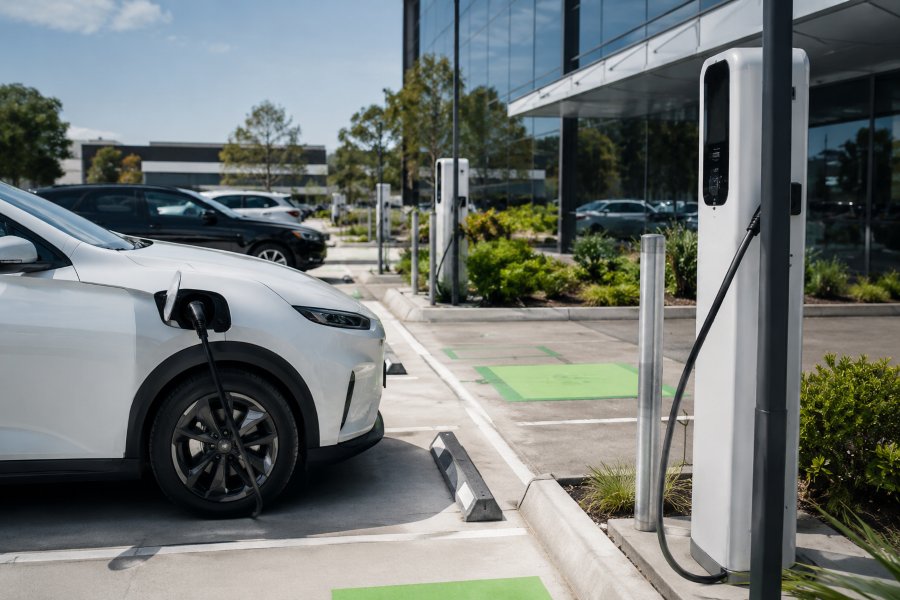
Bollard and protective infrastructure — charging units require protective bollards to prevent vehicle impact. These must be positioned without encroaching on required bay dimensions or pedestrian circulation paths.
Line Marking Requirements for EV Charging Bays: What AS/NZS 2890.1:2021 and AS 1742.11 Require
Getting the line marking right on EV charging bays is both a compliance obligation and a practical necessity — poorly marked EV bays are consistently occupied by non-EV vehicles, undermining the entire investment in charging infrastructure.
The Department of Climate Change, Energy, the Environment and Water minimum operating standards for EV charging infrastructure confirm that each EV charging bay must be clearly identified with appropriate signage and pavement markings to prevent non-EV vehicles from occupying charging spaces (Source: DCCEEW — Minimum Operating Standards: EV Charging Infrastructure). Clear, distinctive marking is not just a compliance requirement — it is the operational solution to bay misuse, and distinctive green marking significantly reduces casual encroachment by non-EV vehicles.
The Required Line Marking Elements
Under AS/NZS 2890.1:2021 and AS 1742.11, a compliant EV charging bay requires:
Green bay infill — a 1,000mm x 1,000mm green square with a white vehicle and plug symbol painted on the ground. Green is the internationally recognised colour for EV charging infrastructure and is referenced in council development guidelines and strata management best practices. For outdoor commercial car parks in Melbourne, UV-stable commercial-grade traffic paint or thermoplastic is required to maintain colour integrity. Cheap green paints fade badly because the pigments are not UV stable — quality materials deliver 4–6 years of colour stability under typical Melbourne conditions.
“EV Charging Only” pavement text — similar to “Accessible Parking” text in DDA bays, this ground-level text within the bay reinforces the charging designation and reduces casual misuse.
Vertical signage at 1.5m height — upright “Electric Vehicle Charging Only” signs must be installed at a minimum height of 1.5 metres, positioned to be visible from the vehicle circulation aisle before a driver commits to a parking manoeuvre. Signage must comply with AS 1742.14 (Traffic control devices for parking signage).
Standard bay dimensions — minimum 2.4m x 5.4m, though a minimum 2.5m to 2.6m bay width is strongly recommended to allow drivers to move around the vehicle while connected to a charger. This extra 200mm prevents cable access issues and reduces the risk of vehicle door contact with charging equipment.
Slip resistance compliance — green infill paint and thermoplastic must meet AS 4586 slip resistance classification. Smooth painted surfaces become dangerously slippery when wet. A quality line marking service Melbourne car park operators rely on will use textured thermoplastic or aggregate-added paint for EV bay infill to maintain compliant slip resistance.
DDA-Accessible EV Charging Bays: A Mandatory Requirement, Not an Option
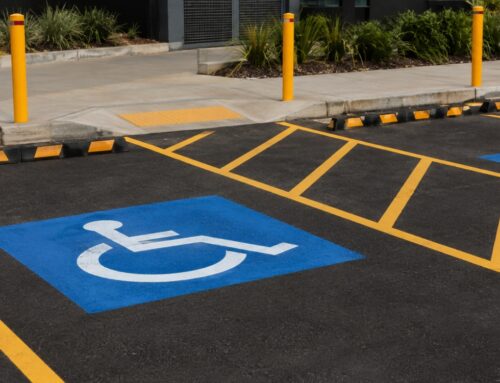
Accessible EV charging bays are a compliance obligation that many commercial car park operators fail to plan for until it’s too late. The Disability Discrimination Act (DDA) and AS/NZS 2890.6 apply to EV infrastructure just as they apply to standard car park facilities.
The DCCEEW minimum operating standards for EV charging infrastructure confirm that accessible EV charging bays must be provided, with chargers required to meet the relevant standards in accordance with AS/NZS 2890.6 for off-street parking for people with disabilities (Source: DCCEEW — Minimum Operating Standards: EV Charging Infrastructure). In commercial developments, a minimum proportion of EV charging bays must be fully accessible. This means:
- Minimum 3.2m bay width — the same dimensional requirement as any accessible parking bay under AS/NZS 2890.6, providing the necessary width for wheelchair transfer alongside the charging cable
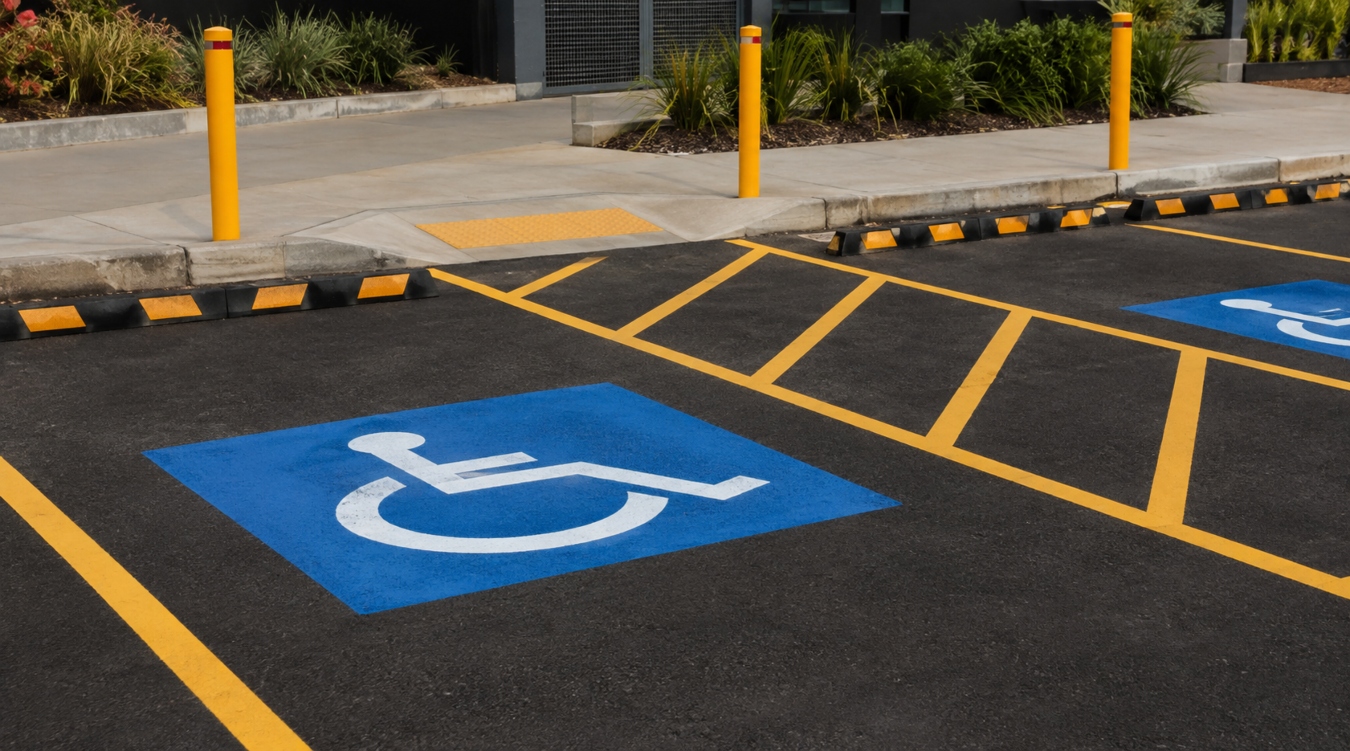
- A 2.4m shared zone alongside the accessible EV bay, clearly delineated with hatching and forming part of a continuous accessible path leading to the building entrance
- Combined accessible parking and EV charging symbols — both the International Symbol of Access (ISA) and the EV charging symbol must be marked on the ground
- Charging station placement — the charging unit must be sited so that a wheelchair user or person using a mobility aid can reach the charging port and operate the equipment without assistance
- Controls within reach range specified in AS 1428.1:2009 (Design for access and mobility)
The cable itself presents an accessibility challenge that is often underestimated. A cable draping across a pedestrian walkway or adjacent bay creates a trip hazard for all users and a barrier for vision-impaired or mobility-impaired individuals. Cable management — spring-loaded retractors, wall-mounted holsters, or overhead cable management systems — is not optional in a DDA-compliant EV charging bay.
A quality car park construction service Melbourne businesses use for EV bay integration will design the bay layout, charging station position, cable management, and accessible path of travel as an integrated package — not as separate trades solving separate problems.
Existing Car Parks: Can You Retrofit EV Charging Bays?
The majority of Melbourne’s commercial car parks were constructed before EV charging was a regulatory consideration. The question most property managers are asking right now is: do we need to rebuild, or can we retrofit?
The honest answer is: most existing car parks can be retrofitted — but rarely without civil works. Here is what a retrofit assessment typically reveals:
Bay dimension non-compliance — AS/NZS 2890.1:2021 introduced updated requirements for EV charging bay dimensions that differ from those applicable under the 2004 version of the standard. Commercial car parks marked under the 2004 standard — particularly those where EV charging equipment has since been retrofitted — may not meet current requirements for effective bay width once charging hardware and bollards are installed (Source: Standards Australia — AS/NZS 2890.1). Retrofitting EV bays without first verifying bay geometry against the current standard is a false economy that risks council non-compliance notices during future development assessment or audit.
Pavement condition — high dwell times in EV charging zones accelerate surface wear. Spalled, cracked, or inadequately drained pavement must be addressed before line marking is applied.
Aisle width — charging bollards and their protective footprints reduce the effective aisle clearance available to adjacent vehicles. AS/NZS 2890.1:2021 specifies minimum aisle widths for 90-degree parking of approximately 5.8m to 6.2m depending on user class (Source: Standards Australia — AS/NZS 2890.1). EV charger installation in car park aisles already near the minimum clearance threshold must be carefully assessed — a bollard encroaching even 200–300mm into the aisle can render it non-compliant and require costly remediation.
Electrical infrastructure routing — conduit routes through finished car park ceilings cross ventilation ductwork, sprinklers, and fire services. Retrofitting conduit through a finished ceiling is consistently more expensive than installing it during construction. EV distribution boards must be positioned to minimise cable run lengths, and routes must be coordinated with existing mechanical services.
For large commercial car parks, the ABCB’s NCC 2025 guidance recommends a whole-of-building approach — installing backbone electrical infrastructure, including bus duct routes and conduit pathways from the distribution board to within 10 metres of all future EV charging spaces — so that individual chargers can be added to any bay without major additional works (Source: ABCB — NCC 2025 Guidance Material: Electric Vehicle Charging). The design stage of a building is the most cost-effective time to install these pathways, as retrofitting conduit through a finished car park ceiling — crossing ventilation ductwork, sprinklers, and fire services — costs significantly more than incorporating it during construction.
The Civil Works Sequence for EV Charging Bay Installation
Whether you are constructing a new commercial car park or retrofitting an existing one, the civil works follow a defined sequence that must be completed before electrical installation begins.
- Site assessment and layout design — assess existing bay dimensions, pavement condition, drainage, aisle widths, and electrical infrastructure routing against AS/NZS 2890.1:2021 requirements. Identify which bays require widening, repaving, or drainage modification to accommodate EV charging equipment.
- Pavement works — repair or replace deteriorated pavement in the designated EV charging zone. Ensure surface drainage is adequate, cross-fall is within compliant tolerances, and the surface meets AS 4586 slip resistance requirements.
- Bollard installation — install protective bollards for charging unit protection. Position bollards to avoid encroachment on bay effective width or pedestrian circulation.
- Accessible path works — for DDA-compliant EV charging bays, install or upgrade the accessible path of travel from the bay to the building entry. This may include kerb ramp installation, TGSI (tactile ground surface indicator) placement, and footpath upgrades.
- Line marking — apply EV bay line marking to AS/NZS 2890.1:2021 and AS 1742.11 standards. This includes green infill, EV symbols, “EV Charging Only” pavement text, bay line dimensions, accessible bay hatching and symbols, directional arrows, and vertical signage installation.
- Electrical installation — only after all civil and line marking works are complete should the electrical contractor install conduit, cabling, load management systems, and the chargers themselves.
This sequence matters because electrical contractors who find non-compliant bay geometry or damaged pavement after arriving on site cause costly delays and project rework. Engaging a car park construction service Melbourne commercial operators trust to manage the civil scope first prevents this.
Frequently Asked Questions
Q1. Do commercial car parks in Victoria need to be EV-ready under NCC 2025?
Ans – Yes. The National Construction Code 2025 mandates EV-readiness infrastructure for new commercial car parks in Victoria. Since May 2024, all new apartment builds in Victoria have already been required to be EV Ready under NCC 2022, and NCC 2025 extends these requirements to commercial developments — mandating conduit, cabling pathways, and switchboard capacity for future EV charger installation. Councils across Melbourne have seen a 40% increase in requests for detailed EV management plans as this obligation takes effect.
Q2. What are the line marking requirements for EV charging bays in Australia?
Ans – Under AS/NZS 2890.1:2021 and AS 1742.11, EV charging bays require: a minimum 1,000mm x 1,000mm green square with a white vehicle and plug symbol on the ground; upright “Electric Vehicle Charging Only” signs at minimum 1.5m height; standard bay dimensions of minimum 2.4m x 5.4m (with 2.5m–2.6m width recommended); and slip-resistant paint or thermoplastic. Accessible EV bays require minimum 3.2m width under AS/NZS 2890.6, combined accessible parking and EV charging symbols, and a 2.4m shared zone.
Q3. How much does it cost to add EV charging bays to a commercial car park in Melbourne?
Ans – Civil and line marking costs for EV charging bay integration in Melbourne vary by site. Line marking for EV bays including green infill and symbols typically costs AUD $300–$800 per bay. Pavement repair or resurfacing works are priced on site conditions. Electrical infrastructure ranges from AUD $500–$1,500 per bay for EV-ready conduit to AUD $2,500–$5,000+ per bay for installed AC chargers. DC fast chargers cost AUD $10,000–$50,000+ per unit. A free site evaluation from a car park construction service Melbourne provider experienced in EV bay integration is the best starting point for accurate project budgeting.
Q4. Do EV charging bays need to be DDA compliant in Victoria?
Ans – Yes. Under the Disability Discrimination Act and AS/NZS 2890.6, a proportion of EV charging bays in commercial developments must be fully accessible. By 2026, industry projections indicate that 5% of EV charging bays in new commercial developments must meet accessibility standards — requiring minimum 3.2m wide bays, a 2.4m shared zone, combined accessible and EV charging symbols, and charging stations positioned for independent wheelchair access.
Q5. Can I add EV charging bays to an existing car park without rebuilding it?
Ans – In most cases, yes — but rarely without any civil works. A retrofit assessment must verify that existing bay dimensions comply with AS/NZS 2890.1:2021 for EV equipment footprint, that pavement condition is adequate, that drainage is sufficient, and that aisle widths are not compromised by charger bollards. A civil contractor experienced in both car park construction service Melbourne and line marking service Melbourne should conduct this assessment before any electrical work is commissioned.
Q6. What is the correct green colour for EV charging bay line marking in Australia?
Ans – Green is the internationally recognised and emerging Australian standard colour for EV charging bay identification, referenced in AS/NZS 2890.1:2021 and various council development guidelines. For outdoor car parks in Melbourne, UV-stable commercial-grade traffic paint or thermoplastic is required to prevent premature fading. Quality materials deliver 4–6 years of colour stability. Smooth green surfaces must include aggregate or textured finish to maintain AS 4586 slip resistance classification in wet conditions.
Q7. How many EV charging bays do I need in my Melbourne commercial car park?
Ans – NCC 2025 requirements vary by development type and scale. At minimum, new commercial car parks must provide EV-ready backbone infrastructure sized for full future EV build-out. For commercial buildings over 100 bays, a whole-of-building EV infrastructure approach — installing backbone conduit and cabling pathways throughout so chargers can be added without major retrofit — is the most cost-effective long-term strategy. For council-specific planning requirements in Casey, Greater Dandenong, Monash, Kingston, Frankston, Hume, or other Melbourne LGAs, consult a civil contractor experienced in car park construction service Melbourne and current NCC 2025 requirements.
How Infra Projects Group Delivers EV Charging Bay Integration for Melbourne Commercial Car Parks
Infra Projects Group is a trusted car park construction service Melbourne and line marking service Melbourne businesses, councils, and developers rely on for compliant, future-ready commercial car park delivery across Victoria.
Our team manages the complete civil scope of EV charging bay integration — from pavement assessment and repair, bay widening, drainage upgrades and bollard installation, through to AS/NZS 2890.1:2021 and AS 1742.11 compliant line marking with green thermoplastic infill, EV symbols, “EV Charging Only” pavement text, and DDA-accessible bay marking. We coordinate directly with your electrical contractor so that the civil and electrical scopes proceed in the correct sequence — eliminating the costly delays and rework that occur when electrical crews arrive at sites with non-compliant bay geometry or unfinished pavement.
With 75+ completed civil infrastructure projects across Melbourne and regional Victoria — including commercial car parks, industrial hardstands, council car parks, and retail centre refurbishments — we deliver EV bay integration that meets council requirements, NCC 2025 obligations, DDA standards, and AS/NZS 2890 line marking specifications.
We deliver:
- Site assessment against AS/NZS 2890.1:2021 EV bay requirements
- Pavement repair, resurfacing, and drainage works
- DDA-compliant accessible EV bay design and construction
- AS/NZS 2890.1 and AS 1742.11 compliant line marking including green thermoplastic EV infill
- Bollard installation and cable management civil works
- Full coordination with electrical contractors and council approvals
- Transparent, itemised AUD pricing with no hidden costs
📞 Call 0430 314 949 ✉ Email info@infra-projects.com.au
🌐 Request your Free Site Evaluation at infra-projects.com.au/contact-us/
Serving Melbourne and regional Victoria — Casey, Cardinia, Greater Dandenong, Monash, Kingston, Frankston, Hume, and surrounding council areas.
Related Services from Infra Projects
- Car Park Construction Melbourne — compliant commercial car park construction across Victoria
- Line Marking Melbourne — AS/NZS 2890 compliant line marking for car parks, warehouses, and roads
- Footpath Construction Melbourne — DDA-compliant footpath and accessible path construction
- Retaining Wall Construction Melbourne — commercial and industrial retaining wall solutions
- Civil Infrastructure Project Management — end-to-end project management for complex civil works
- Contact Infra Projects for a Free Site Evaluation
All regulatory references are current as of July 2026. NCC 2025 requirements may vary by council and development type — always confirm specific obligations with your local council or a registered building surveyor before commencing works. Sources cited throughout this article link to the original publications referenced.
Published by Infra Projects Group Pty Ltd | infra-projects.com.au