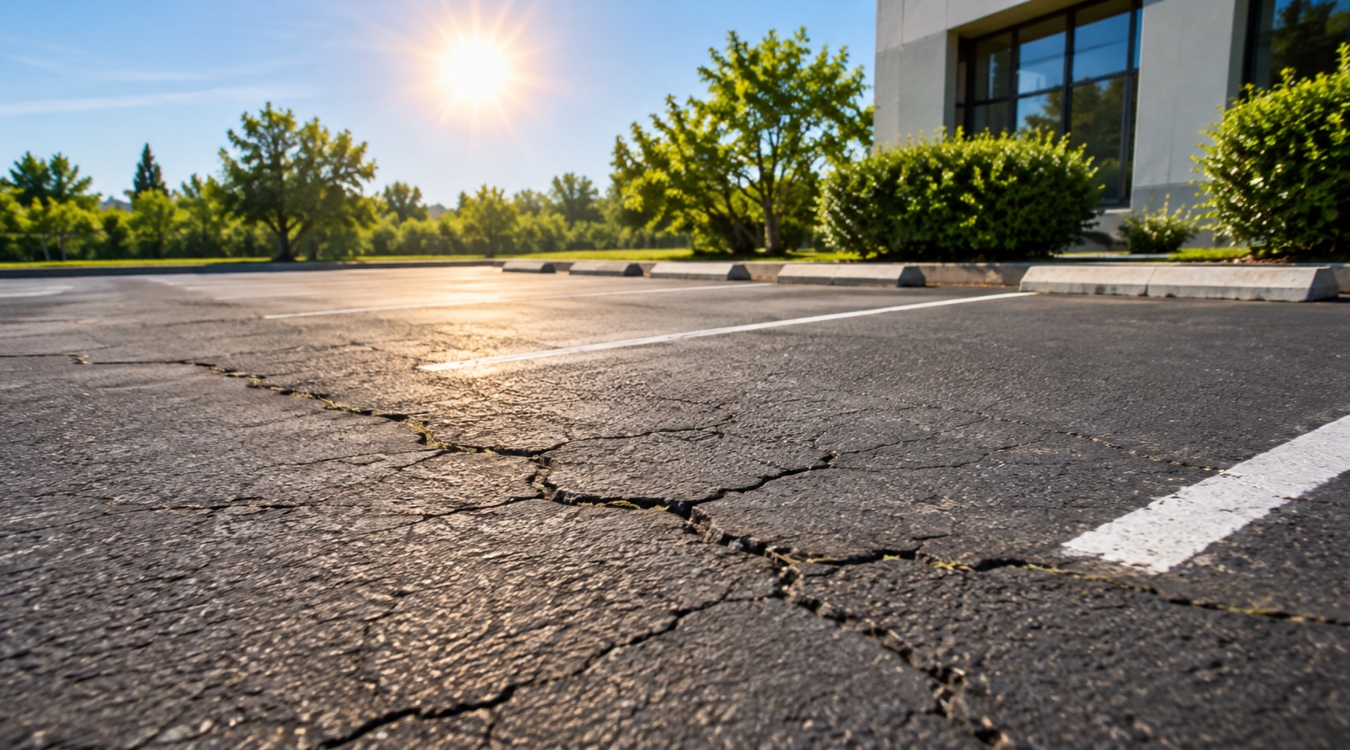
Summer is weeks away, and now is the best time to find heat-related defects. This guide explains how heat damages pavements, what to look for, and what a car park construction service in Melbourne should specify.
What Summer 2025-26 Showed Melbourne Property Owners
The Bureau of Meteorology’s summer 2026 summary for Melbourne recorded these peaks:
- 42.9 °C at Olympic Park on 9 January 2026
- 45.6 °C at Laverton RAAF on 27 January 2026, the hottest reading across Greater Melbourne sites
- Summer rainfall at Olympic Park of only 55% of the long-term average, leaving the ground beneath pavements dry
The summer mean maximum at Olympic Park (25.9 °C) was close to average. Pavements fail under the peaks, not the averages.
Air temperature is not the number that matters for a car park. The Austroads sprayed seal design guide, a road-pavement method used here as a guide, calculates maximum pavement surface temperature as the 90th percentile maximum air temperature plus an offset based on latitude. For locations between 35°S and 41°S, which includes Melbourne, the offset is 21 °C. Applied to a 40 °C air temperature, that suggests a surface near 61 °C. This is an illustrative design estimate, not a measurement of any particular site.
The outlook is not easing. CSIRO projections reported by the Victorian Government suggest Victorian towns could see roughly double the number of very hot days by the 2050s under high emissions, compared with 1986 to 2005.
Five Ways Heat Damages a Car Park
| Defect | What you see | Why heat causes it | Typical risk |
| Rutting and shoving | Wheel-path depressions, ridges near turning areas | Binder softens under hot, slow, heavy traffic | Ponding and trip hazards; heavy trucks and bins speed up damage |
| Flushing and bleeding | Shiny, black, sticky patches | Softened binder rises to the surface, especially in binder-rich mixes | Slippery surface; bitumen tracked onto tyres, shoes and into buildings |
| Cracking | Longitudinal, alligator or edge cracks | Hot-cold cycling and binder ageing make asphalt brittle | Water entry, base failure, potholes after storms |
| Faded line marking | Bays and arrows hard to read | UV, heat and traffic wear down paint and thermoplastic | Unclear bays and accessible parking |
| Concrete joint and slab distress | Spalled joint edges, slab edge cracks, missing sealant | Slabs expand in heat, and blocked or failed joints cannot absorb the movement | Trip edges and water entering the base |
Why This Is a Compliance Issue, Not Only a Maintenance One
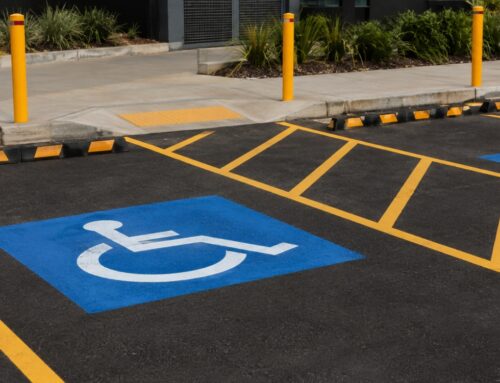
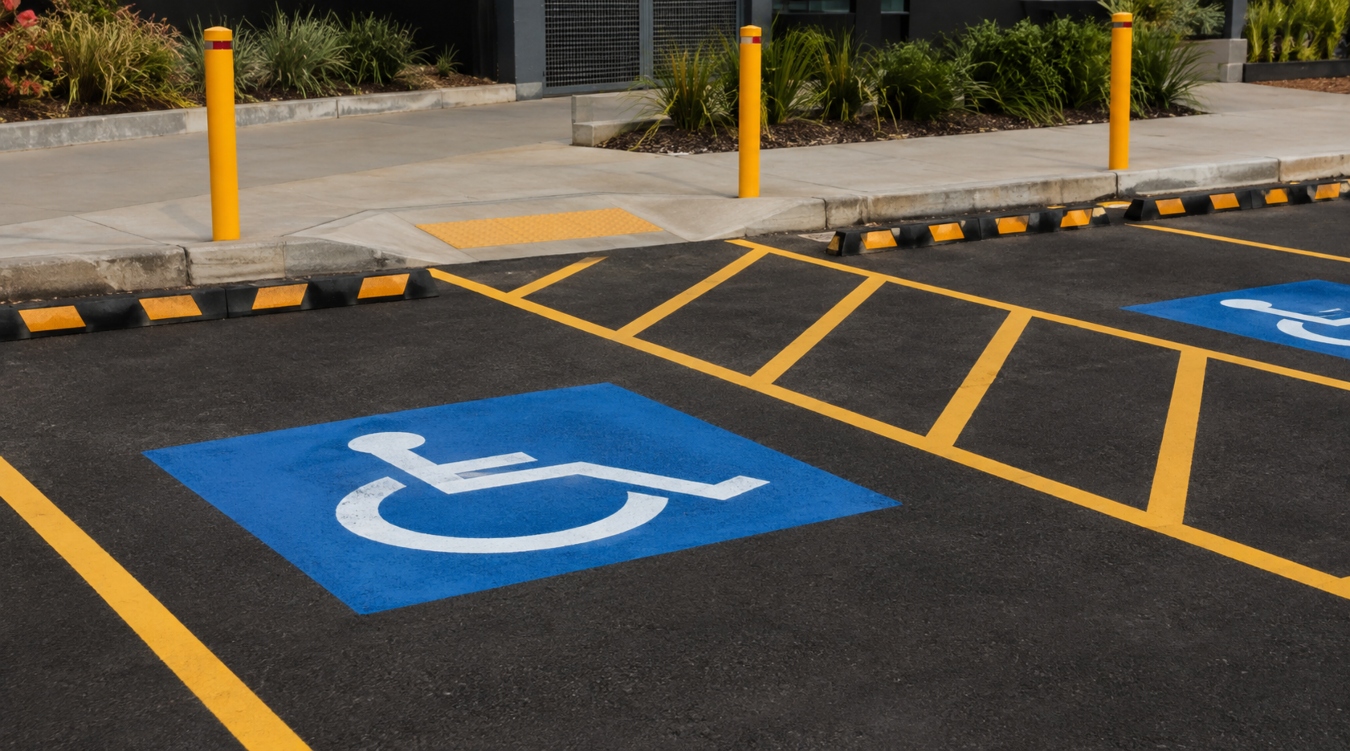
Accessible parking depends on clear markings, compliant gradients and a smooth path of travel. If a bay marking fades or a surface ruts near a ramp, your DDA compliant car park may no longer perform as designed under AS/NZS 2890.1 and AS/NZS 2890.6.
- Faded line marking makes bays, shared zones and accessible parking hard to read. See our line marking service in Melbourne.
- Surface defects at kerb ramps and crossings create trip hazards for pedestrians and people using mobility aids. See our footpath construction service.
Pre-Summer Car Park Inspection Checklist
Walk the site in daylight, ideally after rain so that ponding shows up.
- [ ] Cracks wider than a few millimetres, especially along edges and joints
- [ ] Wheel-path depressions or ridges in turning areas, entries and loading zones
- [ ] Shiny, soft or sticky patches that mark vehicle tyres
- [ ] Ponding after rain, which signals fall problems or base movement
- [ ] Faded bays, arrows and accessible parking symbols
- [ ] Earlier patches that have sunk or cracked
If you tick more than two, book an assessment.
Repair, Resurface or Reconstruct?
| Condition | Usual response | Why |
| Minor cracking and faded markings | Crack sealing and re-marking | Cheapest option when the base is sound |
| Widespread surface ageing, ravelling, shallow rutting | Resurfacing (mill and replace, or overlay) | Restores the wearing course when the base is sound |
| Deep rutting, alligator cracking, repeated pothole patches | Partial or full reconstruction | Indicates base failure, not a surface problem |
The deciding factor is the condition of the base, not the surface. A car park contractor in Melbourne should confirm it with a site assessment, and often with cores or test pits, before quoting.
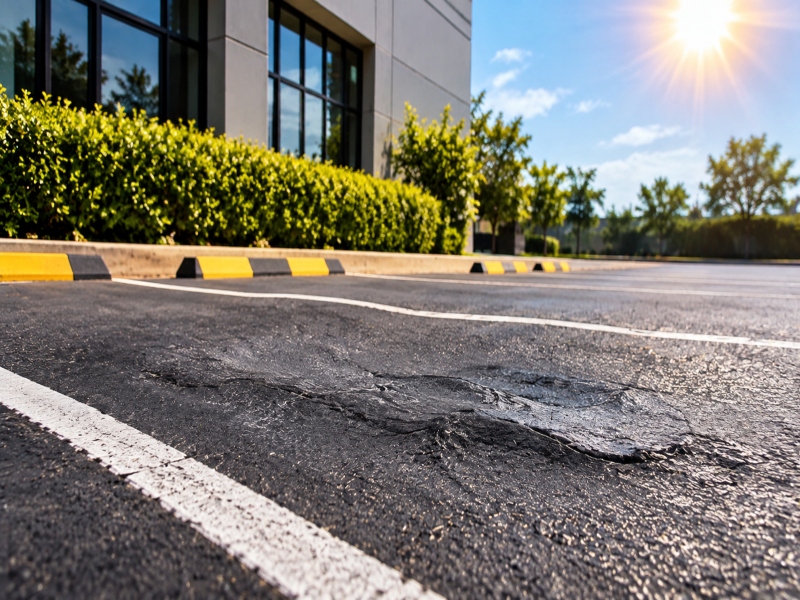
What a Heat-Resilient Car Park Specification Looks Like
For new car park construction in Melbourne or a full rebuild, the specification should address heat from the start. A pavement engineer should confirm each item below for your site:
- Binder selection: Austroads sprayed seal guidance classifies pavement temperature regimes as low (below 52 °C), medium (52 to 58 °C) or high (above 58 °C) and uses them to select modified binders. Ask your contractor which binder the design uses and why.
- Drainage: Provide correct falls and working pits so water does not pond and weaken the base.
- Concrete areas: Space and seal joints properly, particularly in loading zones and bin areas.
- Line marking: Choose a material suited to the surface and traffic, and apply it to a clean, sound surface with timing agreed for new asphalt.
How Infra Projects Group Approaches Heat-Prone Car Parks
As a Melbourne civil contractor with more than 75 completed projects across Victoria, we follow four steps on car park construction jobs:
- Site assessment: We inspect the surface, drainage, falls and compliance gaps such as accessible bays and ramps.
- Survey and design: We survey levels and layout, then match the scope to what the pavement needs.
- Staged works: We plan around tenants, customers and deliveries. Our project management service coordinates trades, permits and staging.
- Line marking finish: We re-mark bays, arrows and accessible parking to the relevant standards.
The aim is to avoid paying for a reconstruction you do not need.
Frequently Asked Questions
Q1. Does heat damage asphalt car parks in Melbourne?
Ans – Yes. Hot weather softens the binder in asphalt, which can cause rutting, shoving and flushing under traffic. Over time, heat, UV and oxygen also age the binder, so the surface becomes brittle, cracks and loses stone.
Q2. How hot does a car park surface get in Melbourne?
Ans – Austroads guidance estimates maximum pavement surface temperature at about 21 °C above the 90th percentile peak air temperature for latitudes between 35°S and 41°S. At a 40 °C air temperature, that is roughly 61 °C. It is a design estimate, and actual temperatures vary with surface colour, shade, wind and material.
Q3. How do I know if my car park needs resurfacing?
Ans – Widespread cracking, shallow rutting and faded markings suggest resurfacing. Deep ruts, alligator cracking or recurring potholes suggest base failure and reconstruction. A site assessment confirms which.
Q4. Is asphalt or concrete better for a hot climate like Melbourne’s?
Ans – Both can perform when designed for the traffic. Asphalt is quick to lay and repair but more sensitive to heat and slow heavy loads. Concrete resists rutting but needs well-sealed joints.
Q5. How much does car park resurfacing or reconstruction cost in Melbourne?
Ans – Cost depends on area, condition, base repair, drainage, access and line marking. A site assessment gives a firm scope and price. See our car park construction service.
Q6. What should I look for in a car park contractor in Melbourne?
Ans – Choose a contractor who inspects before quoting, explains whether the problem is the surface or the base, understands DDA and council requirements, and offers coordinated line marking.
Get Your Car Park Assessed Before Summer
If your car park shows heat damage, or you are planning a new build, Infra Projects Group can inspect, advise and deliver. We provide a car park construction service in Melbourne and across Victoria, including resurfacing, reconstruction, drainage, accessible parking and line marking.
Call 0430 314 949, email info@infra-projects.com.au, or request a site assessment.
Sources
- Bureau of Meteorology, Melbourne in Summer 2026
- Austroads, Guide to Pavement Technology Part 4K: Selection and Design of Sprayed Seals, determination of maximum pavement surface temperature
- Victorian Government, Victoria’s climate science
- Victorian Government, Climate-Ready Victoria: Greater Melbourne
General information only. Pavement condition and repair scope depend on site-specific assessment by a qualified engineer or contractor. Standards cited include AS/NZS 2890.1 and AS/NZS 2890.6.