We have been working in Melbourne’s western growth corridor for years. Wyndham, Tarneit, Truganina, Hoppers Crossing: these are not abstract LGA names to us. They are active project sites. And we’ve watched this part of Melbourne grow at a pace that most of the city doesn’t fully appreciate.
So when West Tarneit Station opens on Sunday 13 September 2026, we are not just watching as observers. We’re watching as a civil infrastructure contractor that understands exactly what a new train station means for the commercial, industrial, and community infrastructure that will grow around it.
Our view is direct: the opening of West Tarneit Station is not the end of a construction story. It is the beginning of a decade of civil infrastructure demand across Melbourne’s west. And for property owners, developers, facility managers, and businesses in Tarneit, Wyndham Vale, Truganina, and Hoppers Crossing: the time to plan your car park, bus stop, and access infrastructure is now, not after the suburb catches up.
Quick Answer: What Is West Tarneit Station and What Does It Include?
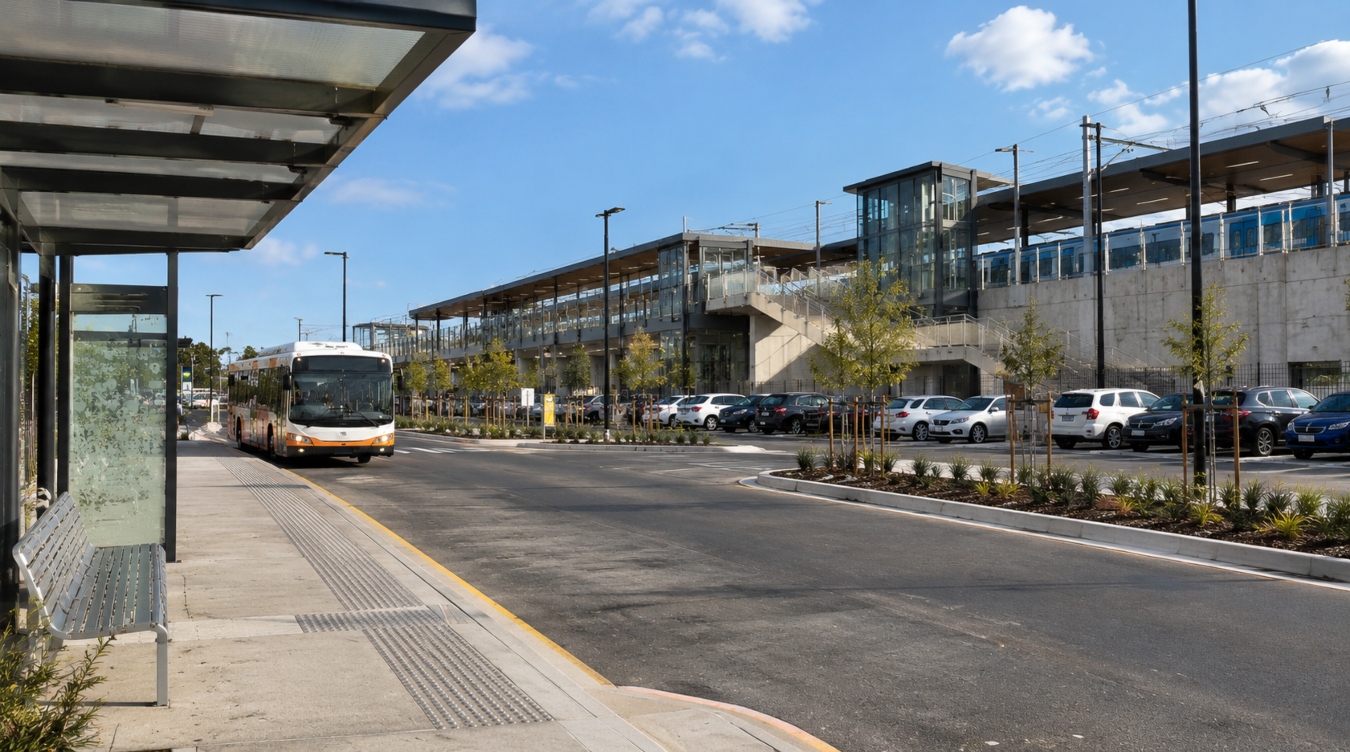
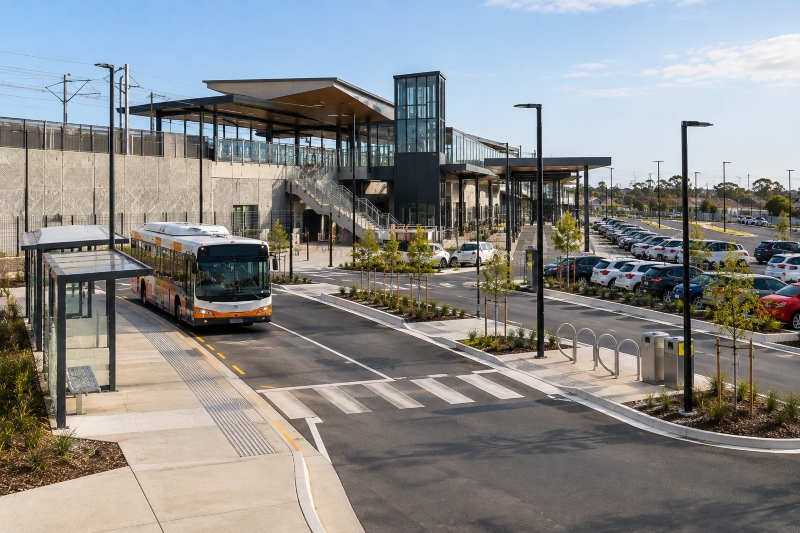
West Tarneit Station opens on 13 September 2026 on the V/Line Geelong Line, located near the corner of Leakes and Davis Roads, Tarneit, in the City of Wyndham. The station includes a 400-space commuter car park, a 4-bay bus interchange, an accessible pedestrian underpass, separated walking and cycling paths, a 26-space Parkiteer secure bike cage, and 30 bicycle hoops. It is fully DDA-compliant and has been designed to accommodate future rail expansion and population growth in Melbourne’s western corridor (Source: Victoria’s Big Build).
What We Know About Growth Corridors and Civil Infrastructure Demand
We’ve delivered civil infrastructure projects in Melbourne‘s outer growth corridors for over a decade, covering Casey, Cardinia, Hume, and now increasingly Wyndham. And in every corridor, we have seen the same sequence play out.
Major public transport arrives. Commercial development follows. Civil infrastructure demand spikes.
It’s not speculation. It is the growth corridor playbook. A new station removes the single biggest barrier to commercial investment in an outer suburb: commuter connectivity. Once that barrier goes, the development cascade begins fast.
Here’s what that looks like on the ground:
- Activity centres and neighbourhood retail strips fill and expand
- Industrial estates intensify, attracting logistics, manufacturing, and trade businesses
- Medical centres, childcare facilities, and schools grow to serve the incoming population
- Community and council facilities get built or upgraded to keep pace
Every single one of those developments needs a car park. Most need a bus set-down zone. All of them need compliant footpaths and line marking.
Now look at the numbers. Tarneit’s population surged from 34,562 in 2016 to 56,370 in 2021, representing a 63% increase in five years (Source: ABS 2021 Census). Wyndham City is forecast to approach 500,000 residents in the coming decades (Source: Wyndham City Population Forecast, .id informed decisions). This is not a suburb finding its feet. It is a municipality in the middle of a generational infrastructure build-out, and West Tarneit Station has just hit the accelerator.
On top of that, Wyndham City Council’s Connecting Wyndham program is rolling out road upgrades across the same corridor right now:
| Project | Timeline |
| Leakes Road duplication — Tarneit Road to Derrimut Road | Late 2026 |
| Tarneit Road and Shaws Road intersection upgrade | Late 2026 |
| Dohertys Road duplication — planning and design ($2.4M allocated) | 2027 |
Road upgrades of this scale create direct civil infrastructure obligations for every commercial site on those corridors, requiring car parks to be redesigned for new access points, footpaths to be realigned, and line marking to be reviewed in full.
Our assessment: the western growth corridor is entering its most active civil infrastructure phase in a generation.
What This Means for Car Park Construction in Wyndham and Tarneit
Let’s talk about what we actually see coming.
The 400-space commuter car park at West Tarneit Station sets a benchmark for what the surrounding precinct will need. Those 400 spaces will fill quickly, because Wyndham’s population is not a prediction. It is already here. When they fill, the overflow goes to surrounding streets and commercial car parks.
For commercial and retail operators in the Tarneit precinct, including activity centres, medical facilities, supermarkets, childcare centres, and industrial businesses, this creates both an opportunity and an obligation.
The opportunity: car parks that are well-signed, well-marked, and clearly managed become an asset in a suburb where parking is increasingly contested. A property with a clean, compliant, clearly line-marked car park with adequate accessible bays stands out in a development market where many older car parks were built before current standards applied.
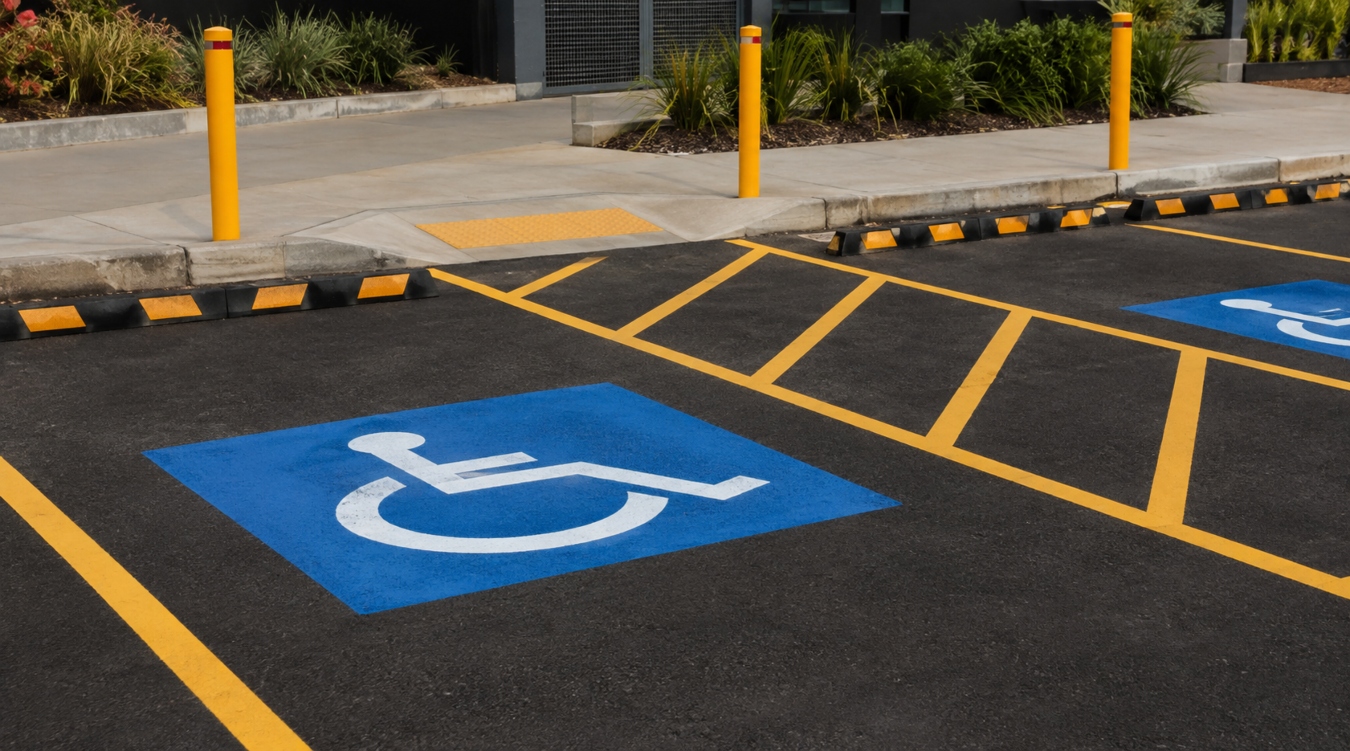
The obligation: Any new development or significant upgrade in Wyndham City requires a car park that meets current standards, including AS/NZS 2890.1:2021 for layout and bay dimensions, AS/NZS 2890.6:2022 for accessible bays, and Victoria’s Amendment VC277 PTAL framework for required bay counts. With Tarneit increasingly well-served by public transport following the station opening, many sites in the suburb will move into Category 3 or Category 4 PTAL classifications, resulting in lower minimum parking requirements but also the introduction of maximum parking limits that can catch developers off-guard.
From our experience delivering car park construction service Melbourne across Hume, Dandenong South, and Casey, we know that growth corridor car parks have specific challenges that inner-suburban car parks do not. The soils in Wyndham’s western corridor are predominantly reactive clay and alluvial silt, particularly near Davis Creek and the western drainage channels. Sub-grade preparation on these sites is non-negotiable. Surface failure on a car park built without proper sub-grade investigation is a common and costly problem in outer suburban Melbourne. A site assessment before design is not a suggestion in this corridor. It is a necessity.
What the 4-Bay Bus Interchange Tells Us About Commercial Bus Stop Demand
West Tarneit Station’s 4-bay bus stop interchange is a significant piece of civil infrastructure, and its real impact on the western precinct goes well beyond the station boundary.
Here’s what a major bus interchange actually triggers:
A new V/Line interchange anchors bus routes feeding in from the surrounding suburb network, including Truganina, Hoppers Crossing, Wyndham Vale, and the precincts further west. Every stop along those routes now sits under a compliance spotlight it didn’t face before. The interchange sets a visible DDA benchmark. Non-compliant stops on the feeder network become conspicuous by comparison.
In our experience delivering bus stop construction across Melbourne’s growth corridors, a new major station consistently triggers a compliance wave across a 10–15 kilometre catchment. It looks like this:
| Who Acts | What They Do |
| Local councils | Audit existing bus stop infrastructure across feeder routes |
| Commercial developers | Include bus set-down zones as conditions in development applications |
| Schools | Upgrade set-down areas to meet DDA standards |
| Medical centres | Add sheltered, accessible waiting areas adjacent to car parks |
What DDA compliance actually requires for a bus stop or set-down zone:
Under the Disability Standards for Accessible Public Transport 2002, every bus stop and commercial set-down zone must include:
- Accessible boarding area with compliant dimensions
- Kerb ramps at all entry and exit points
- Tactile ground surface indicators (TGSIs)
- Shelter and seating
- Clear pedestrian path connecting the stop to adjacent footpaths and car parks
A bus set-down zone that misses any of these is not a cosmetic issue. It is a legal non-compliance that councils and the Australian Human Rights Commission treat as seriously as any other DDA breach.
If your commercial site in Tarneit, Wyndham Vale, or Truganina has an existing or planned bus set-down zone, assess it now, before a council audit or development application turns it into a mandatory condition with a fixed deadline.
Footpath Infrastructure in the Western Precinct — What’s Coming and Where Developers Get It Wrong
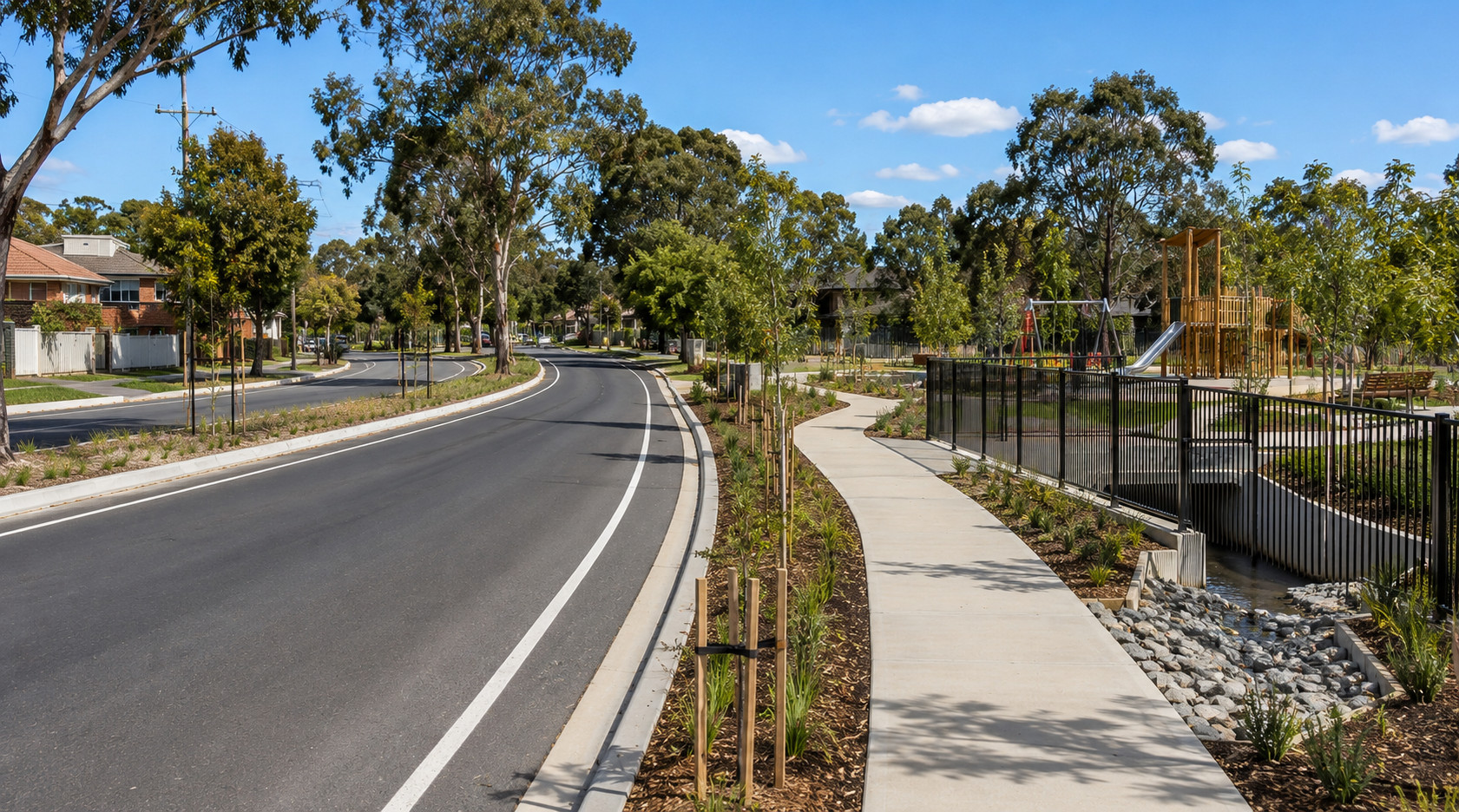
The pedestrian underpass and separated cycling paths at West Tarneit Station are not just station features. They are the opening chapter of a connected pedestrian network across the entire western precinct, and every developer, council, and commercial operator in the catchment will be expected to connect to it.
The planning framework is already in place. Wyndham City’s draft Derrimut Road West Urban Design Framework, covering up to 917 new homes, shops, offices, and community spaces in Tarneit North, mandates:
- Connected pedestrian and cycling networks
- EV charging infrastructure in off-street car parks
- Minimum 35% tree canopy coverage for car parks
- Water-sensitive urban design treatments
This means footpath construction and accessible path works will be a condition of planning approval, not an optional upgrade, across a significant portion of the western precinct’s next development wave.
The two failure modes we see most often in growth corridor footpath works:
- Wrong standard for the use: Residential pavement specs applied to commercial or mixed-use sites that legally require heavier-duty construction and stricter DDA compliance. Councils catch this at final inspection. Rectification is expensive.
- Disconnected accessible path: A technically compliant footpath that still leaves a wheelchair user or mobility aid user blocked by a grade change, a kerb lip, or a missing kerb ramp before they reach the building entry. The footpath passes inspection. The accessible path of travel doesn’t.
Getting both right from the start means correct pavement specification and a fully connected accessible path. That is what separates a compliant footpath construction outcome from one that creates rework. It requires a contractor who knows the standards and has delivered in this exact type of growth corridor environment.
That is exactly what we do.
Our View: Plan Your Civil Infrastructure Now, Not When the Suburb Has Caught Up
Here is the expert opinion we share with every developer, facility manager, and property owner we work with in growth corridor suburbs like Tarneit: the best time to plan your car park, bus stop, footpath, and line marking infrastructure is before the suburb’s rapid development phase peaks, not after.
After the peak, civil contractors are stretched, material lead times extend, council assessment queues lengthen, and the cost premium for reactive works rises. We’ve seen this in Casey. We’ve seen it in Cardinia. The western growth corridor is heading into exactly this phase as West Tarneit Station opens.
The businesses and property owners who move early, commissioning a site assessment, confirming their compliance obligations, and planning their civil infrastructure against the current standards, will have projects delivered on their terms, on their timeline, and at a price that reflects a planned engagement rather than an urgent one.
Infra Projects Group is already active in Wyndham City. We know the councils, we know the soils, and we know the standards. Our free site evaluation gives you a clear picture of what your site needs, with no obligation and no pressure, just an expert assessment from a civil team that has delivered infrastructure in Melbourne’s growth corridors for over a decade.
Frequently Asked Questions
Q: When does West Tarneit Station open?
West Tarneit Station opens on Sunday 13 September 2026, with passenger services beginning with the first V/Line train that day. The station is located near the corner of Leakes and Davis Roads, Tarneit, in the City of Wyndham (Source: Victoria’s Big Build).
Q: What civil infrastructure is included at West Tarneit Station?
The station includes a 400-space commuter car park, a 4-bay bus interchange, an accessible pedestrian underpass with ramp and stair access, separated walking and cycling paths, a 26-space Parkiteer secure bike storage, and 30 bicycle hoops. The station precinct is fully DDA-compliant and designed to accommodate future rail expansion.
Q: What does West Tarneit Station mean for car park construction in the western growth corridor?
The station’s opening accelerates commercial and retail development across Tarneit, Wyndham Vale, Truganina, and Hoppers Crossing. New activity centres, retail car parks, industrial estates, and community facilities all require compliant car park construction, including DDA-accessible bays, AS/NZS 2890.1:2021 layout compliance, and EV-ready infrastructure. Infra Projects delivers car park construction service Melbourne across the western growth corridor.
Q: What bus stop construction standards apply to commercial sites near Melbourne stations?
Bus stops and bus set-down zones on commercial sites must comply with the Disability Standards for Accessible Public Transport 2002 and the Disability Discrimination Act 1992. This includes accessible boarding areas, shelter, seating, kerb ramps, tactile ground surface indicators, and clear pedestrian paths connecting the stop to adjacent footpaths and car parks.
Q: Does Infra Projects Group deliver civil infrastructure in Tarneit and Wyndham?
Yes. Infra Projects Group delivers car park construction, bus stop construction, line marking, footpath construction, and retaining wall construction for commercial, industrial, and council clients across Melbourne’s western growth corridor, including Tarneit, Wyndham Vale, Truganina, Hoppers Crossing, and surrounding Wyndham City LGA areas.
Related Services from Infra Projects
- Car Park Construction Melbourne: DDA-compliant car park construction for commercial, industrial and council sites across Victoria
- Bus Stop Construction Melbourne: DDA-compliant bus stop and bus interchange infrastructure across Melbourne’s growth corridors
- Line Marking Melbourne: AS/NZS 2890 compliant line marking for car parks, access roads and industrial sites
- Footpath Construction Melbourne: council-compliant footpath and accessible path construction across Victoria
- Retaining Wall Construction Melbourne: commercial and industrial retaining walls with full AS 4678 engineering
- Civil Infrastructure Project Management: end-to-end project delivery for complex civil works
- Contact Infra Projects for a Free Site Evaluation
Get a Free Site Evaluation: Car Park and Bus Stop Construction in Tarneit and Wyndham
Infra Projects Group is your local civil infrastructure contractor for Melbourne’s western growth corridor. We deliver car park construction, bus stop construction, line marking service, footpaths, and retaining walls, from site assessment and permit coordination through to final inspection and handover.
📞 Call : 0430 314 949 ✉ Email : info@infra-projects.com.au
🌐 Request your Free Site Evaluation at infra-projects.com.au/contact-us/
Serving Melbourne’s western growth corridor and regional Victoria, covering Wyndham, Tarneit, Truganina, Wyndham Vale, Hoppers Crossing, Casey, Cardinia, and surrounding council areas.
This article is intended for general informational purposes only. Civil infrastructure requirements vary by council, zone, overlay, and project type. Always confirm specific obligations with your local council or a qualified civil engineer before commencing works. Sources: Victoria’s Big Build — West Tarneit Station; Wyndham City Council — Connecting Wyndham; Attorney-General’s Department — Disability Standards for Accessible Public Transport.
Published by Infra Projects Group Pty Ltd | infra-projects.com.au